
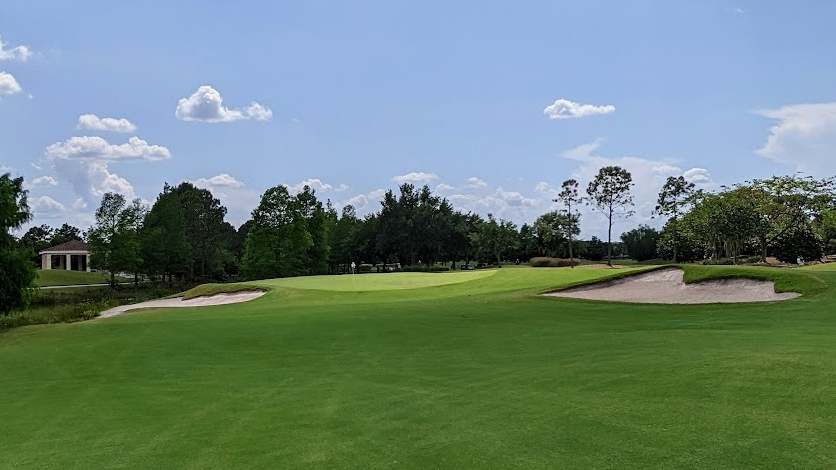
This Shingle Creek Golf Club course review is based on a round played on May 4, 2022 (PM)
Shingle Creek Golf Club is a public golf course in Orlando, FL with a maximum green fee of $200 per round.
F1C’s Final Score: 49/80 (Good)
Learn More: How We Rate Courses
Where to stay? -> Check out F1C’s Orlando Golf Travel Guide
Pull up a chair, settle down by the campfire, and grab your poker and sticks, because it is time for a roast.
First, a bit of Shingle Creek history. The course was originally built in 2003 and designed by local golf architect David Harman, who unfortunately passed away at a young age in 2005. Harman is also credited as a designer for both the Panther Lake and Crooked Cat at Orange County National, just up the road.
Sometime in the mid-2010s, Shingle Creek Golf Club decided it needed a redesign, so it sought out the other local course designer: Arnold Palmer. Oddly enough, Arnold Palmer probably has about as much to do with the design of the present day Shingle Creek as I do. The redesign was actually handled by Thad Layton of the Arnold Palmer Design company. As always, I disclaim what I am about to say is not a personal attack on Layton or his abilities as a designer. Architects are often forced to make decisions that they may not want to make, especially at resort or daily-fee courses who care much more about the quality of their bottom line than the quality of the golf course.
Therefore, in this renovation, Shingle Creek redeveloped an unused parking lot to become part of the golf course, and removed quite a few bunkers from the original design. By my count, the original design had 92 bunkers, a number of which were very large and undoubtedly expensive to maintain; the largest that I could find measured around 8,000 square feet. Bunkers can often be one of the more expensive course items for a golf course to maintain on a daily-fee course. This spread out over nearly 100 bunkers, averaging about 3,000 square feet per bunker, means that Shingle Creek was maintaining plus-or-minus 300,000 square feet of bunkers on a daily basis. Remember, daily fee courses rarely ever close for a maintenance day like private courses, so maintaining these bunkers every morning is a significant task and expense for a daily-fee course.
The new design reduced the bunkers on the course to just 50 and, by visual inspection, more than halved their average square footage. This definitely makes it easier to maintain for the golf course management, and easier for the resort player to play without large bunkers with which to contend with. Everyone wins, right?
Sure, it can work. Bunker removal has been successful at other courses. However, from an overhead inspection, the course that sits on Shingle Creek today is worse than the course it replaced. Shingle Creek is now a disjointed design that feels like misaligned hodgepodge of a course with no identity. That’s because golf courses can’t be put into a blender and made into a cohesive, fruity drink. Every hand that touches a golf course leaves a mark that never fades. Golf courses are more like Play-Doh, and every architect that plays with it is using a different color. In the case of Shingle Creek, the Play-Doh colors clash.
The First Tee
The practice facility is nice at Shingle Creek and we had a good warmup and were ready to play on the first tee. The first hole is a straightaway par-4 with a lake running the length of the hole left. Layton doesn’t wait long to make mistake number one in my book: as useless catch bunkers sit between the lake and the golf hole; one fairway bunker and two greenside. Of course, there’s infinite bailout room to the right.
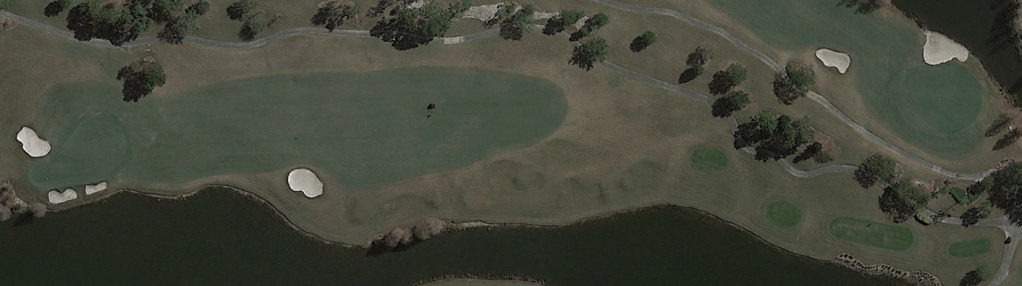
Again, players are already aiming away from the lake on the left without the introduction of a bunker in that spot. The bunker serves no strategic purpose. Every good player is launching this ball to the right fairway or right rough, and the design removes any chance of a good player hitting the ball in the water here. I’m not sure I can blame Layton though, this is probably a design choice made by monied-interests. Resort courses cannot afford to draw negative pace-of-play reviews and the classic bunker-and-bailout design ensures less balls will go in the water, thereby improving pace of play.
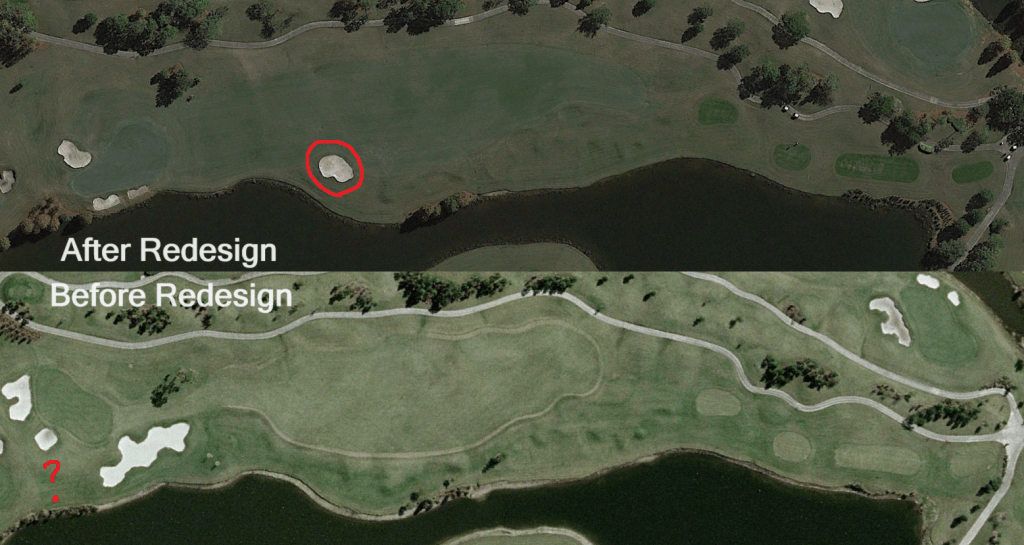
The old hole, before the redesign, was better. Since this is our first look at the old course, here is an interesting discovery: the bunker “style” that was replaced is the same bunker style that is immensely popular now in 2023, with harder-jagged edges that look more natural to the landscape. They replaced these bunkers with a more common, sterile bunker style. Now, the old hole – it was not perfect. For some reason, Harman did not locate the green beside his best feature: the lake. He set the green inland, and made the lake a non-factor on the approach – that sucked too. Essentially what I am saying is that, in its 20 year history, this hole has sucked for every day of its existence, but at least Harman got the tee-shot closer to correct.
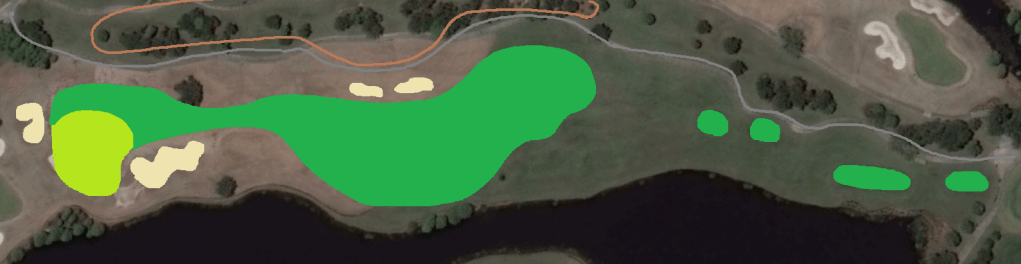
The first hole should have always looked like the drawing above, with the fairway closer to the lake on the approach, and the lake serving as the left hand green-side hazard. The original greenside bunkers could have remained in place, with the addition of two fairway bunkers on the right to complicate a bailout drive. This hole has takes longer on average for a group to play, though. In the mind of these resorts, given the contempt they have for their customers, some may argue that their guests couldn’t tell a difference between the two designs, other than this one takes longer for groups to play and slows down pace of play.
Because, in case you haven’t heard, the goal of golf is to get back home, or back to the hotel room, as quickly as humanly possible.
Let’s talk about the second hole, a mid-length par-5. Here is the overhead view today, a largely characterless hole.
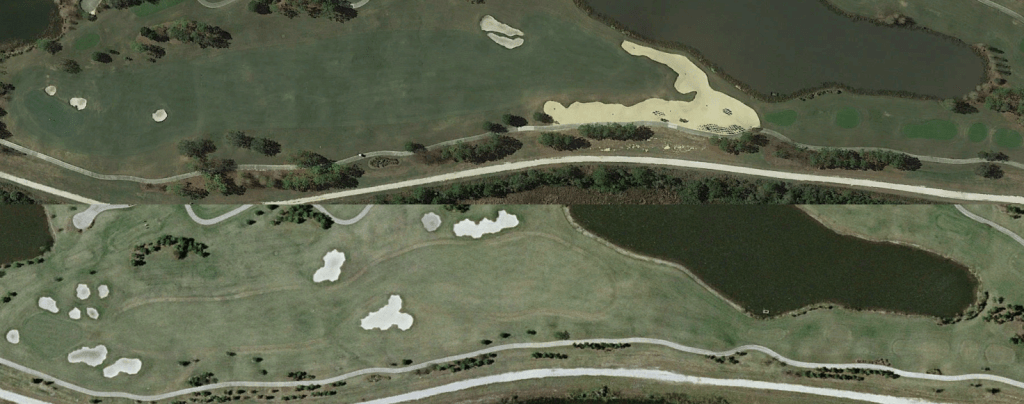
A fairway bunker on the right squeezes the landing area slightly, before a wide open layup shot is slightly complicated by a center line bunker that a player has to choose to carry or layup behind. So, at least there was some consideration of strategy – but let’s not force people to think for too long, we have places to be.
Before the redesign, characterless is not how I’d describe this hole with eleven bunkers, as the old bunker squeezed the same landing area, and two fairway bunkers eventually squeezed the sight line of a layup before an extremely fortified green. This used to be a real risk-reward second shot, the risk provided by a plethora of greenside bunkers.
The third hole was changed for the worse as well. This short par-4 requires only 340 yards to carry the drive to the front edge of the green. Before the redesign, that was a difficult proposition, with a lake and a bunker to carry, and another lake to the left to catch any bailouts. The 3-wood wasn’t an option due to the fairway ending and two large bunkers littering the area between the fairway and the green. The options were simply to try to drive the green or hit a hybrid out to the small fairway that required a certain level of accuracy to find.
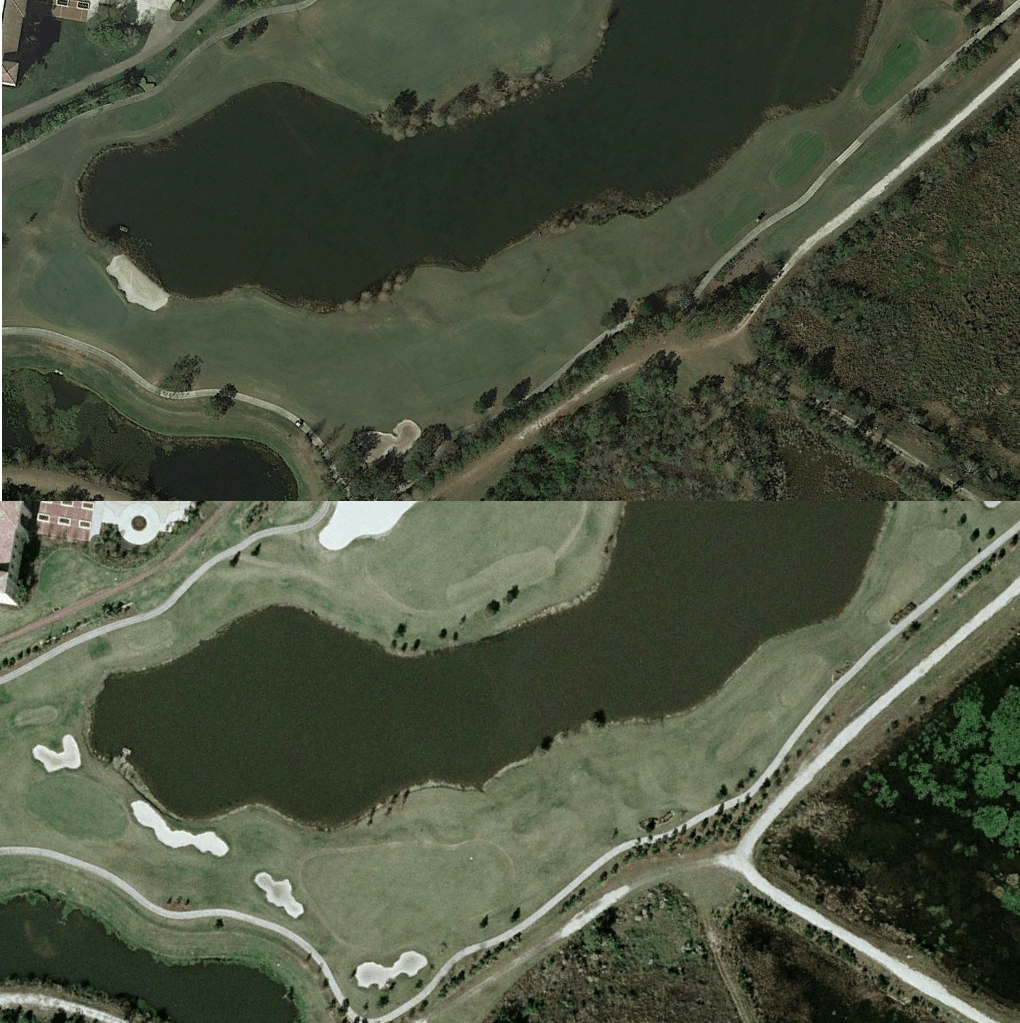
The new hole? The bunkers have all been removed, but for a greenside bunker flanking the front right of the green, and the fairway now curves around the lake. This is good design, on its face, because it does offer more option by allowing to cut off as much of the lake as you can to get it close. Two factors prevent better players from actually doing that though; the bits of leftover Play-Doh from Harman’s design concepts.
First, there’s not only the frontal lake to carry, there’s a lake in the rear that will catch any shot where the angle is miscalculated. There is only 50 yards between penalty hazards here, which means better players will not go for the unnecessary risk of driver.
Second, the hole is not the right length to accomplish the angled-lake concept correctly. If the hole were shorter, it would encourage players to try to fit their drive into this 50-yard gap, because they might leave themselves an eagle putt. At 340 yards, only the professional long drivers have a chance, meaning the calculus reward of being 40-50 yards short of the green is not worth the risk of fitting the drive into a 50-yard gap. If the hole were longer, it may incentivize the player to want to cut more of the angle of the lake. Better players are motivated by the opportunity to hit a 9-iron or wedge into a green instead of a 6-iron. The length of this hole negates that option, and not many better players are going to take more risk to get a 40-50 yard shot, which a no risk option exists that will leave no more than a gap wedge into the green. Even though they are wrong, some better players would even prefer the full gap wedge to a 40-50 yard shot.
So, the hole as it sits today has an illusion of option, but smart players are still playing it exactly the same way as before, when the fairway did not extend to the green. The approach is now made easier by the removal of the visual clutter of the two cross bunkers between the fairway and the green. So, while the design concepts are technically better than before (using your best feature/hazard), the mashed together Play-Doh makes the same as before the redesign with less visual intrigue.

The changes on the fourth hole did not quite fit my eye either. The fourth is a mid-length par-4 that has an elevated green with steep runoffs on each side. The fairway features a cross bunker directly in the middle of the landing area of the tee shot, but the green is actually bunkerless.
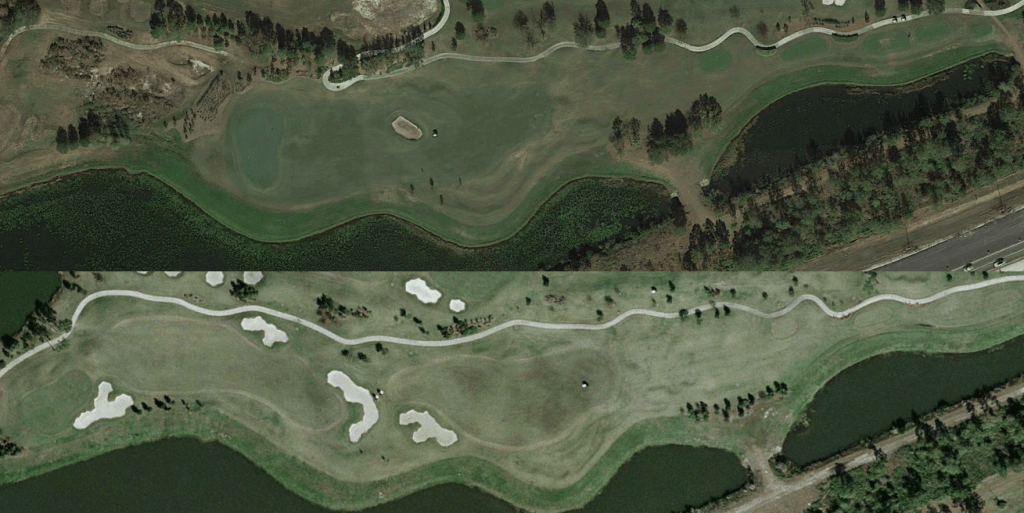
This hole was actually a radical change, from a par-5 to a par-4. Not to be sacrilegious here, but the old hole from the overhead view kind of resembles the fourth at Bethpage Black, a classic design. Maybe this was Harman’s homage to Tillinghast. That hole was ripped up, and the green perched on a hill with the view of the Disney skyline behind the green. In a press release about the redesign, Shingle Creek stated:
Here is a snapshot of some of the fun and exciting shots you’ll face around the new course: #4: Despite measuring 367 yards and having no greenside bunkers, the second shot to the perched green is so difficult to hit with a wedge.
Link
While all of this is true, there’s nothing fun nor exciting about this hole. Its a dead straight par-4, that forces a 3-wood off the tee, and then plays to a green elevated by eight feet. The old hole at least had visual intrigue; this one has a view of the other Rosen hotels.
The next few old holes were completely ripped out. Now, unnatural ruts in the trees about as wide as a golf course sit unmaintained behind the fourth, and the course swings around to the new fifth hole, which was the old seventh. This hole is largely unchanged from the original design as a mid-length par 3.
The next hole, a mid-length par-4, is flanked on the right by the lake from the third hole. This hole is largely the same as well from a design perspective, but the hole was reduced from having one large fairway bunker and four greenside bunkers, to no fairway bunkers and just two greenside bunkers. The hole is basically the same, just easier. The drive is difficult on this hole if a draw is not your natural shot shape, due to the tee box being very close to a group of trees that protect the hotel on the left.
I want to focus on the holes that substantially changed back in 2016, so we now turn to the new seventh hole, which is old ninth, and is another hole that changed par value.

The new hole is on the left, and is a very long par-3 that plays into a rectangular green, with areas to miss long, short, and right. This is a decent hole as its obvious from the length and size/shape of the green that Layton wanted the player to have the option to run this ball up on the green. Not a bad hole, but the hole it replaced was pretty good too. A short, forced-layup par-4 which required some accuracy off the tee. Of course, there’s a row of bunkers between the lake and the fairway, and unlimited bail out room to the right of the old hole, so it was not the best design. The carry over the frontal pond to the green, including that wacky bunker, made for a good finishing hole to the front nine though; more-so than the ninth hole today (which we will see later on).
It is hard for me to say one hole is better than the other here, but certainly the old hole would have been a more memorable hole, due to the aggressive nature of the greenside bunker. Now, a new chipping green and practice bunker sit on the island that was so obviously meant for the ninth green.
This is another example of mixed Plah-Doh: the routing.
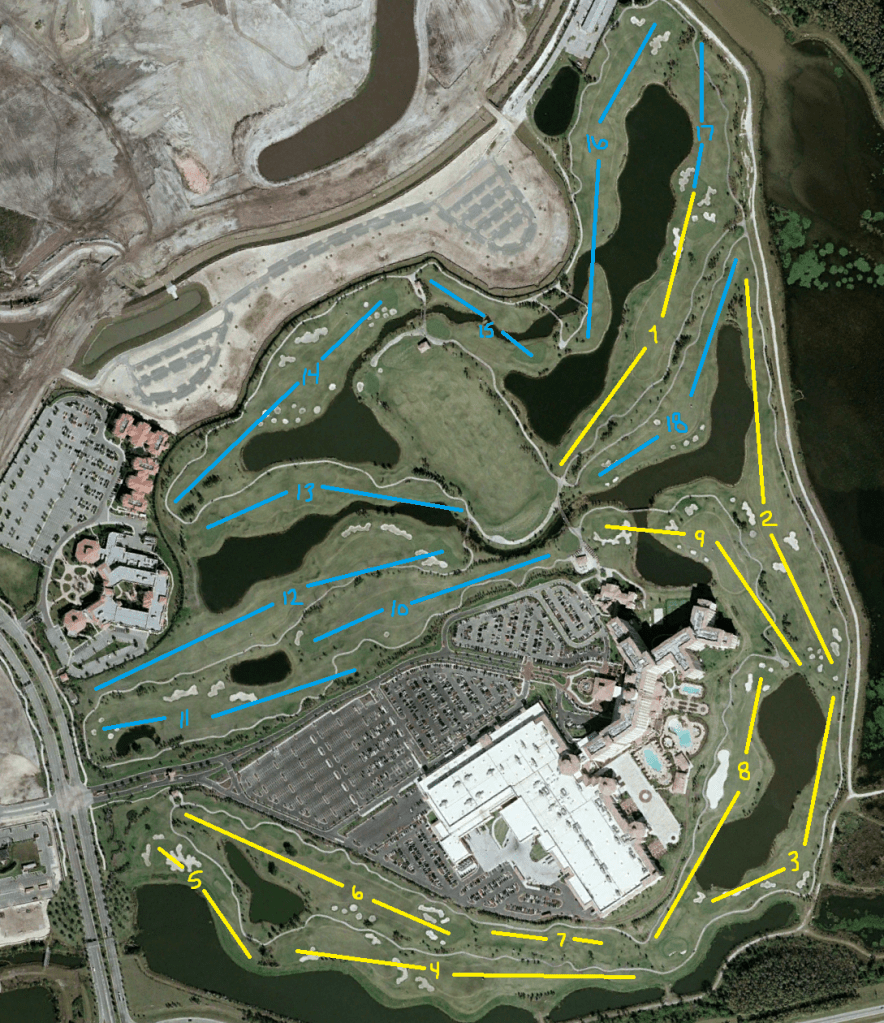
Before, the course had a normal routing, with both nines essentially finishing in the starting and finishing in same place, near the clubhouse and driving range.
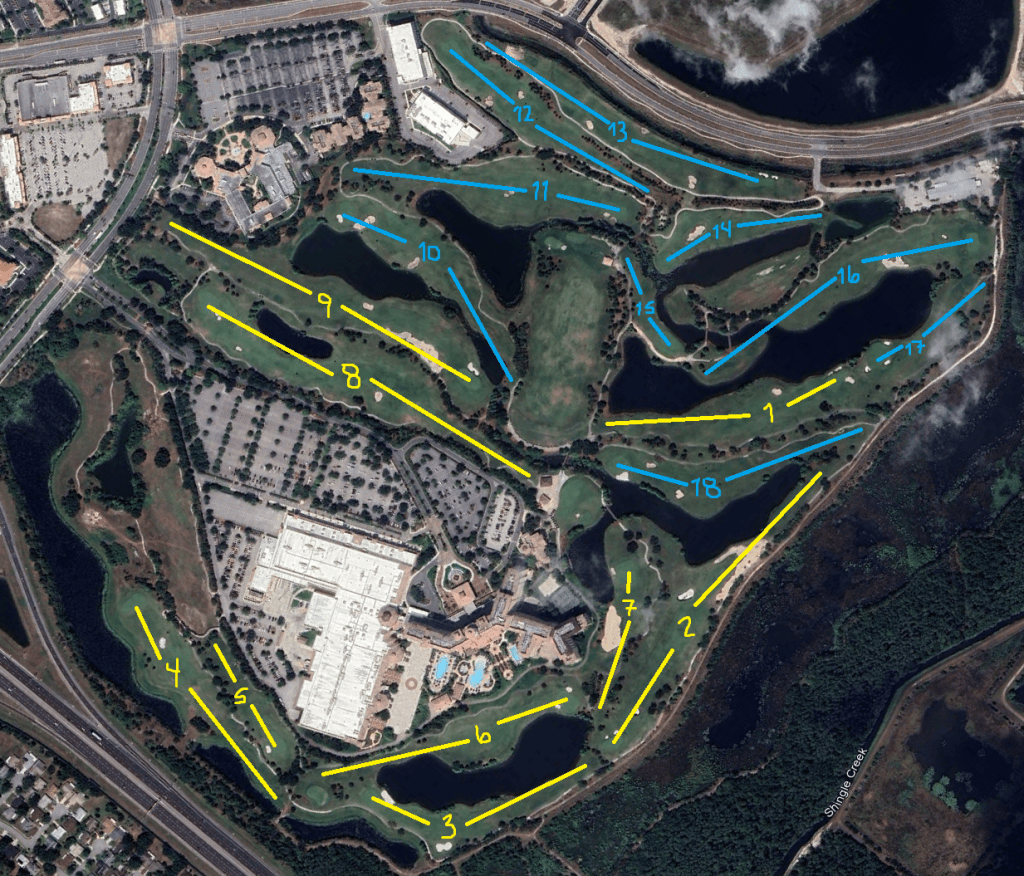
Now, you can see that, after completing the seventh hole, the group needs to drive past the driving range and past the turn shack to the eight hole (the old tenth), and play two parallel holes. Just another example of the discontinuity of the redesign.
I have covered these front nine in perhaps a bit more detail than usual, and the eighth has been converted into a long par-5, with the ninth remaining as a long-par-4 – a tough finish to the front nine. A turn shack awaits, albeit a bit far, before heading back to the tenth.
Making the Turn
On the back nine, I am just going to highlight a few holes and how they have changed in the redesign. First, one of the two holes on this course that are actually good holes, the tenth hole. A medium-length par-4 with a pond flanking its left side close, as well as the distant right across the cart back. The hole uniquely has three steep-lipped bunkers that work from an angle away from the green that provide visual clutter to the approach, but are mostly out of play on all but the fattest of wedges.
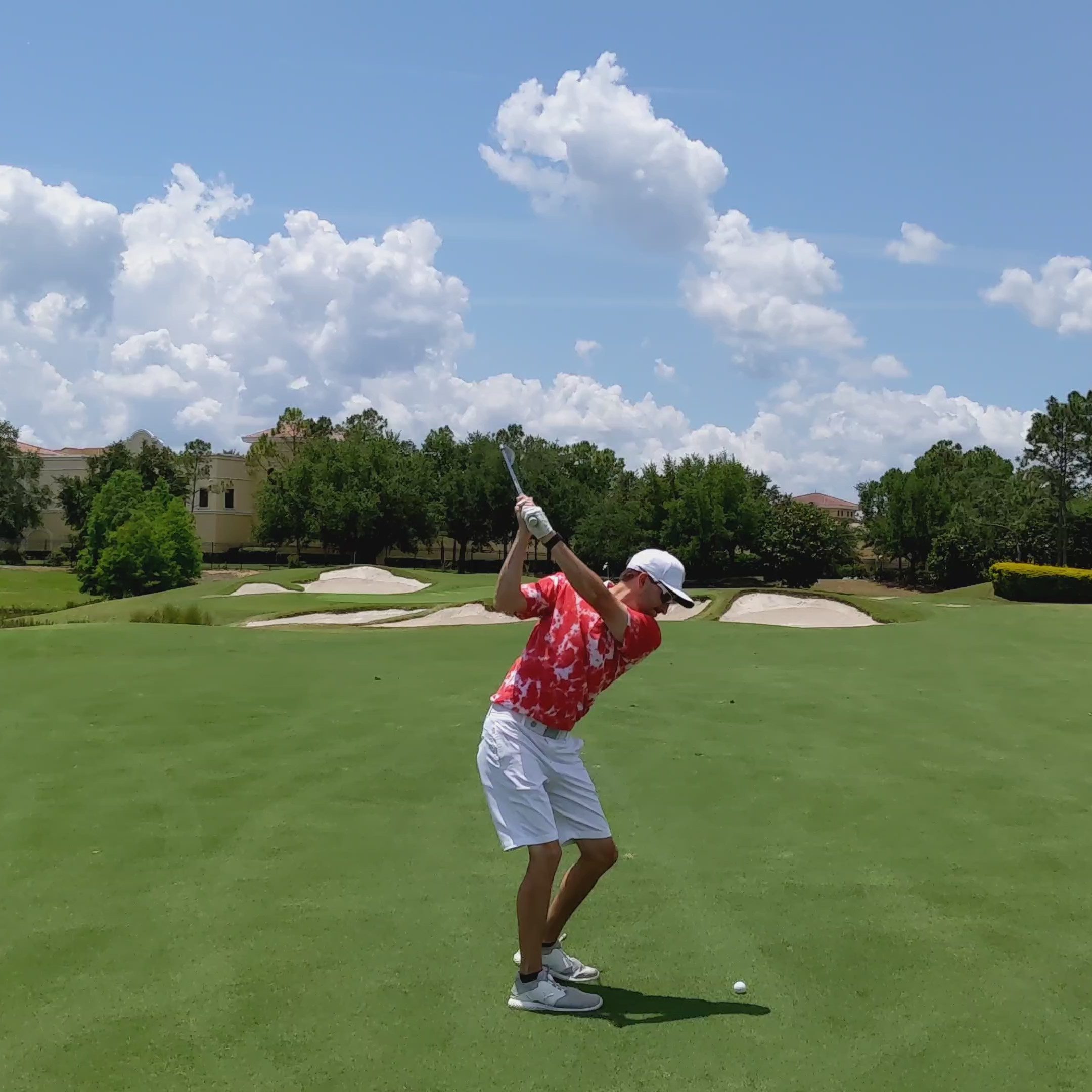
The tenth is the second best hole on the course and provides real strategy and visual intrigue.
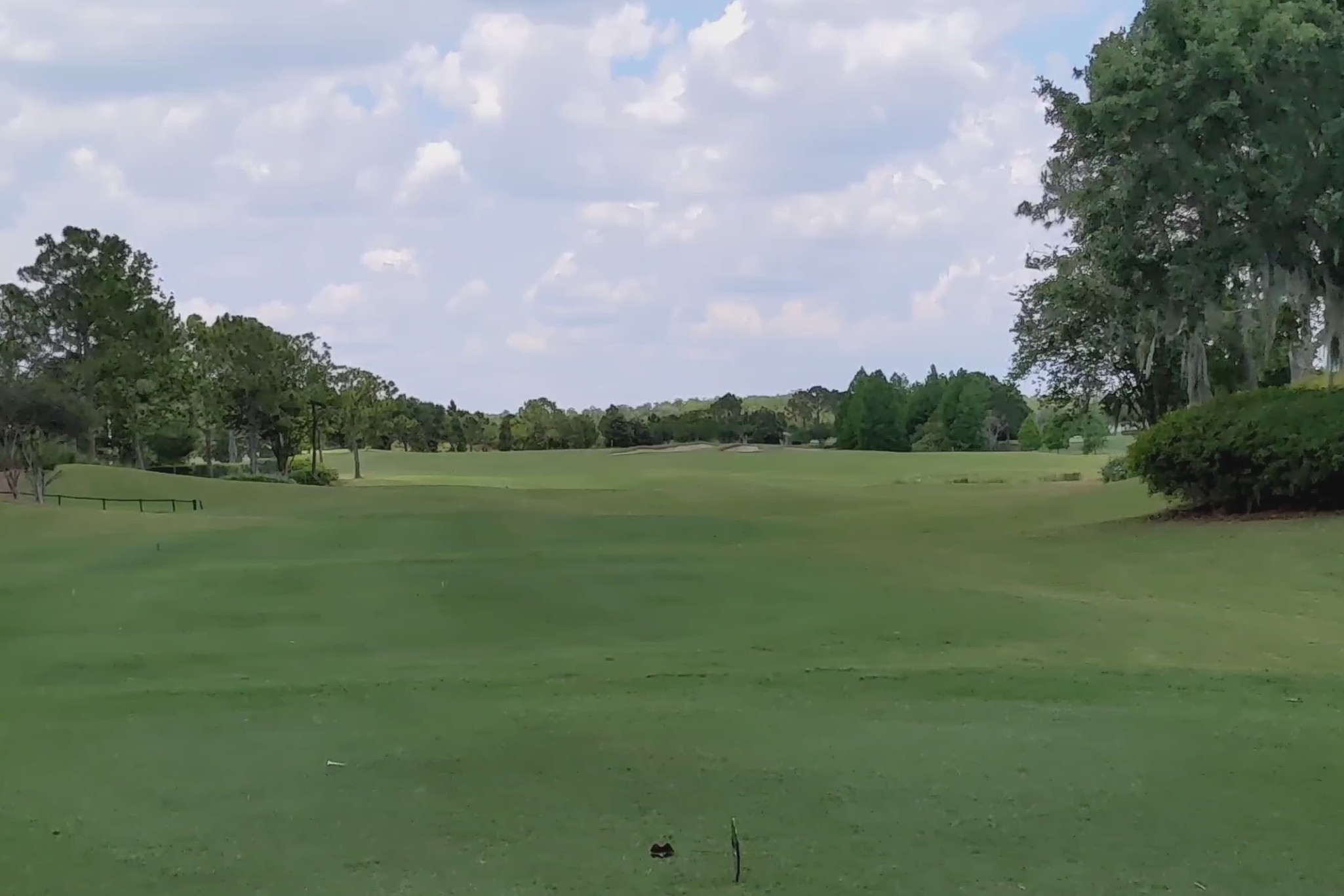
The eleventh moves in the opposite direction as a long par-4 with two small cross bunkers that dot the middle of the fairway in the landing zone. Anything to the right of the cross bunkers will bound to the right towards the rough. The approach is a mid-iron to a green protected by two bunkers on the right.
The next three holes are the new three holes that sit in what used to be an unused parking lot. The twelfth is an uninteresting straightaway par-4, and unfortunately, the thirteenth is an uninteresting straightaway par-5. However, the green on the thirteenth adds some intrigue, as it an oddly shaped long-oval: 15 yards wide by 50 yards long.
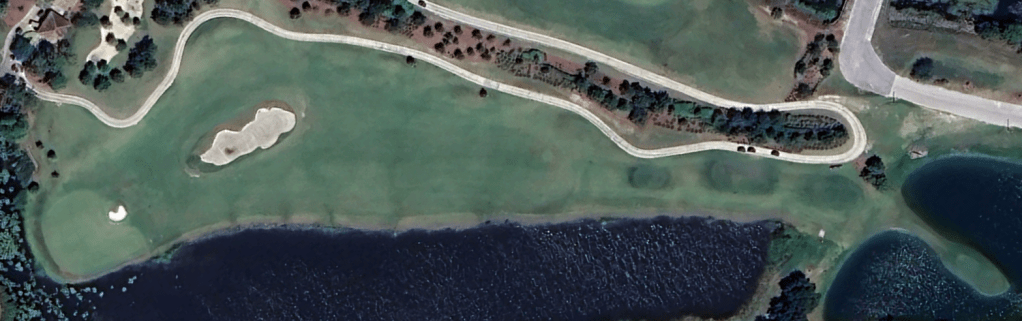
The new fourteenth hole is the best hole on the golf course. The back tee box sits on a narrow peninsula and the green’s front edge sits just 285-yards from this tee. This fairway is two tiered, with the area of the right of the bunker being much higher than the area left of the bunker. The high side can work like a ski-ramp off its back, and the area to the right of the green is significantly downhill and below the surface of the green. The green has a small lion’s mouth bunker that complicates the approach no matter where the flag is
I see no less than four potential ways to play this hole, a welcome change for this course. This hole makes me think the changes and decisions made on this course may not be entirely the decision of Layton. He clearly has good hole designs to offer, and on this one, the owners let him cook.
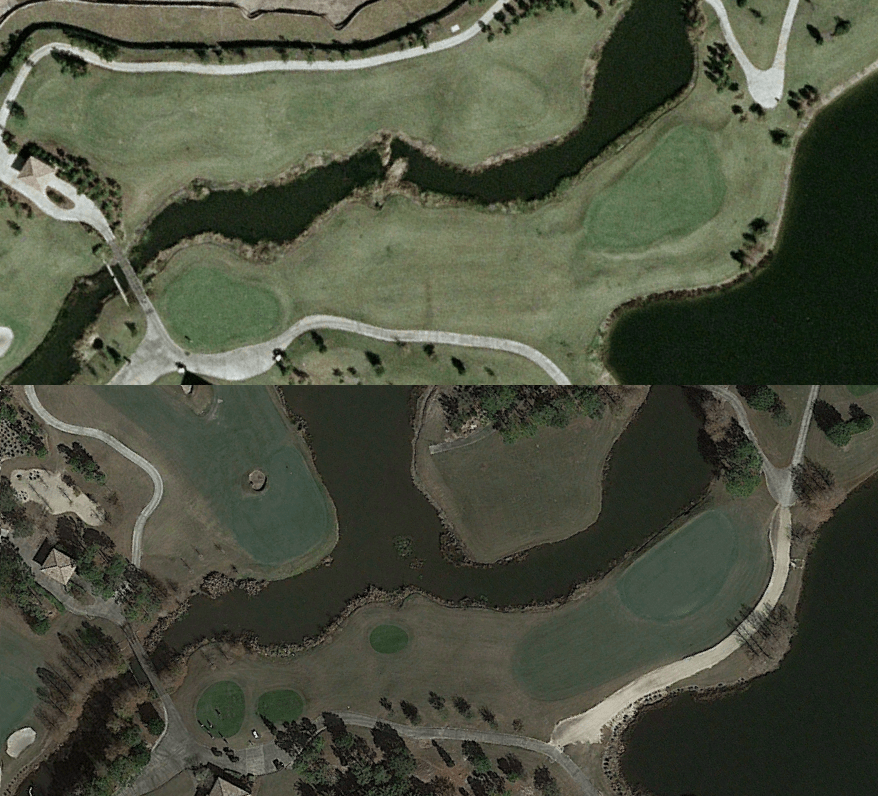
Fifteen is a short, bunkerless par-3 that plays with its main hazard as a pond flanking the entire left side of the hole, and long right of the green. The tee used to be where the fourteenth green is but needed to be relocated due to the new design. While I think this hole got worse with the re-positioned tee, it was never strong to begin with and was a worthy sacrifice for the fourteenth’s design.
The sixteenth hole is a par-5 in name only, as it plays just 483 yards from the back tee, and would play as a par-4 in any competitive golf format. The hole works around a pond on the right, but other than that pond (which my ball found), the hole is largely without hazard as it has no greenside bunkers or hazards. I made a wild par here after one in the water and one in the trees on the left.
The seventeenth received mostly bunker changes, as the long par-3 formerly had a few large greenside bunkers that were shrunk during the renovation. Largely, the hole remains the same and somewhat uninteresting.
The eighteenth is a pleasant par-4 working back towards the clubhouse. This hole received similar treatment in the reduction of bunkers on the left and greenside, with the addition of this visual bunker about 50 yards short and to the right of the green. A pleasant hole, but devoid of any strategy options. It might be one of the better looking holes on the course that exists today and should provide a birdie opportunity to end your round with a good drive.
Final Thoughts
Shingle Creek as it exists today is a good course, but solely a good course. It is made good because of the conditioning and the facilities. Everything was nice, nothing was out of place, the starter was friendly, etc. If golf design is not your thing and you’re just looking to play a round of golf in nice conditions in the Orlando sun, Shingle Creek may be the place for your round.
But, if you’ve made it this far, I am willing to bet golf design is your thing, in which case you’ll find Shingle Creek as discontinuous, sterile, and uninteresting, but-for a few holes. We had a nice round of golf, you will too, and I don’t hesitate to recommend it to others, because I am confident the course will be well kempt.
Just understand that what you are getting is “resort” golf “designed” by “Arnold Palmer design company.”
F1C’s Final Rating
Shot Options: 8
Challenge: 7
Layout Variety: 7
Distinctiveness: 4
Aesthetics: 5
Conditioning: 8
Character: 4
Fun: 6
Total: 49/80
Read More: How We Rate Courses
Ratings Scale Detail
> 70: Top-50 U.S.
65-70: Top-200 U.S.,
60-65: Best-in-State List
57-60: Best-in-state List Contender
53-57: Very Good
48-53: Good
40-48: Average
> 40: Poor

Author: Jaxon MacGeorge
Jaxon is the founder and lead course reviewer at First1000Courses.com. Jaxon has been playing golf for over twenty years, is a scratch handicap, and actively competes in USGA and Tennessee Golf Association (TGA) amateur events. By trade, Jaxon is an attorney and lives in Gallatin, TN, a suburb of Nashville.

 First 1000 Courses
Leave a reply to Course Review: Gaylord Springs Golf Links – First 1000 Courses Cancel reply