

Time to Read:
|
This Atlanta Athletic Club Highlands Course Review is based on a round played on March 30, 2023 (AM)
Atlanta Athletic Club is a private course in Johns Creek, GA (a suburb of Altanta, GA). The guest fee is approximately $225/round.
F1C’s Final Score: 66/80 (Top 200 U.S.)
Learn More: How We Rate Courses
Past, present, and future; that is my takeaway from Atlanta Athletic Club (AAC). Arriving on property, Atlanta Athletic Club almost feels like I was visiting the Monticello or Mount Vernon. Perhaps the feeling was just in my head, but if you are acutely aware of golf history, you know the experience at AAC is part golf round and part golf-history lesson.
The history lesson begins before the golf round in the clubhouse, where a replica of the PGA’s Wanamaker trophy sits in the hallway. AAC has hosted a U.S. Open, a U.S. Women’s Open, a few PGA Championships, a recent Women’s PGA Championship, a Ryder Cup, a U.S. Amateur, a U.S. Women’s Amateur, a U.S. Mid Am, and a U.S. Junior, among other important events. There are truly few places you can visit with this type of major championship pedigree in both the men’s and women’s games. Most of those events have been hosted at their facility in John’s Creek on the Highlands Course, so needless to say – I knew I was in for a test. Further, the Highlands Course is ranked #148 on Golf Digest’s Top-200 List.

The home of Bobby Jones does not disappoint. AAC has an impressive display of history, but unlike what I expected, I departed AAC with the feeling that AAC was not a just relic of history that had been usurped by new, modern courses. AAC has a significant future ahead, evidenced by the several USGA championships it will host in coming years. The feeling was more than just that though. Most of the players I saw practicing on the ridiculously impressive driving range were juniors and younger players. This is a club that is alive and growing, not one stuck in its own past.
Considering the facilities on property, as well as the infrastructure in the area, the majors will return eventually as well. Rightfully so, because as I would find out: the Highlands course is still a seriously good golf course that provides a proper championship test.

The First Tee
I cannot start at the first tee for this review. I have to start at what is the wildest driving range I have ever seen in my life. By my count, I found no less than 10 different putting or chipping greens for warmup. The range has massive grass tees on either side of the range, with plentiful target greens and fairways inside of it. It is truly incredible that there are regular people who get to practice here. I cannot imagine a more ideal facility to practice or learn the game of golf.

We happened to get to the course a little earlier than we normally do, but that was fantastic – this has to be the best course in the world to have a little extra warmup time before your round. Between the history and beauty of the clubhouse, the huge practice green behind the clubhouse, or the amazing practice facility, I’d recommend showing up at least 90 minutes early just to experience it all.
Now, for the actual first tee and picking a tee set from which to play. The Highlands course at AAC can play as long as you’d like, with the championship tees playing a ridiculous 7,613 yards. That is not at elevation or subject to a strong ocean breeze. That’s just seven thousand, six hundred yards of Georgia bermudagrass. I’ll leave that to the pros. We played from a mix of the Gold and Blue, around 7,000 yards. Another quirk about AAC is that we were provided a full pin sheet, detailing exactly where the pins were cut on this day (all courses of top-200 desire should do this). It was a nice touch to a round, and maybe means more to me than some others as I am always in my yardage book.
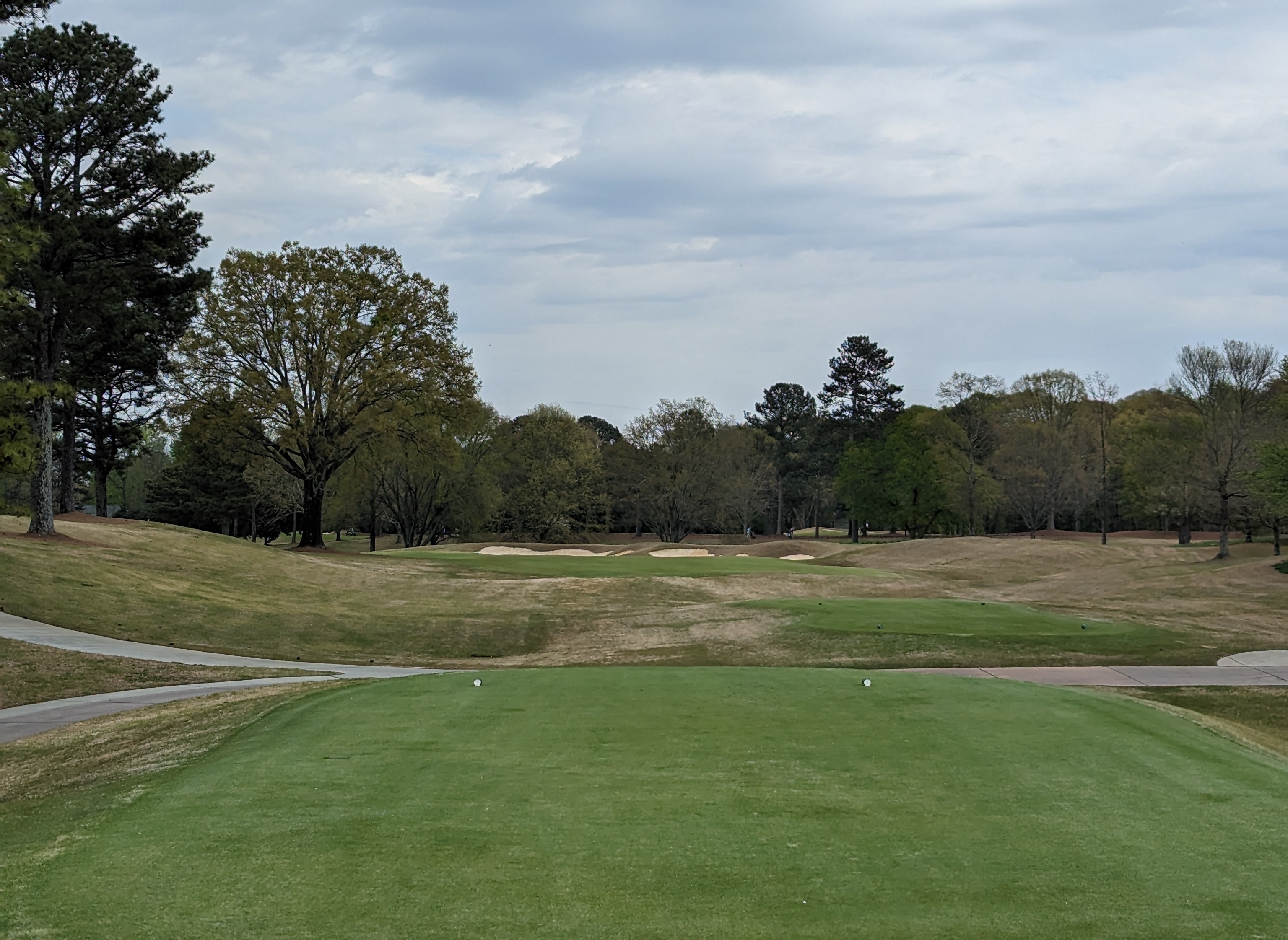
The first hole is a mid-length par-4 that doglegs around a medium-height tree that hugs the inside of the dogleg. A few bunkers tighten the landing area on the right, giving the player a mandate to challenge the large tree on the left if the player elects driver off the tee. Three wood off the first tee would also work, but a weak fairway metal might get a bit blocked out on the left.

The second shot is a bit more straightforward if the drive is successful, as a large green is surrounded by three bunkers on all sides of varying sizes and depths.
The second hole is a straightaway par-5, and if there is any knock on this front nine at Atlanta Athletic Club’s Highlands Course, it is the par-5 holes. Both the second and the fifth holes are par-5s that bend slightly in alternating directions, with deep bunkers on the right of the drive and a collection of deep bunkers near the green. Both of them are perfectly fine golf holes, but perhaps they do not quite inspire the mind or the skill of the expert golfer. They are just average par-5s.
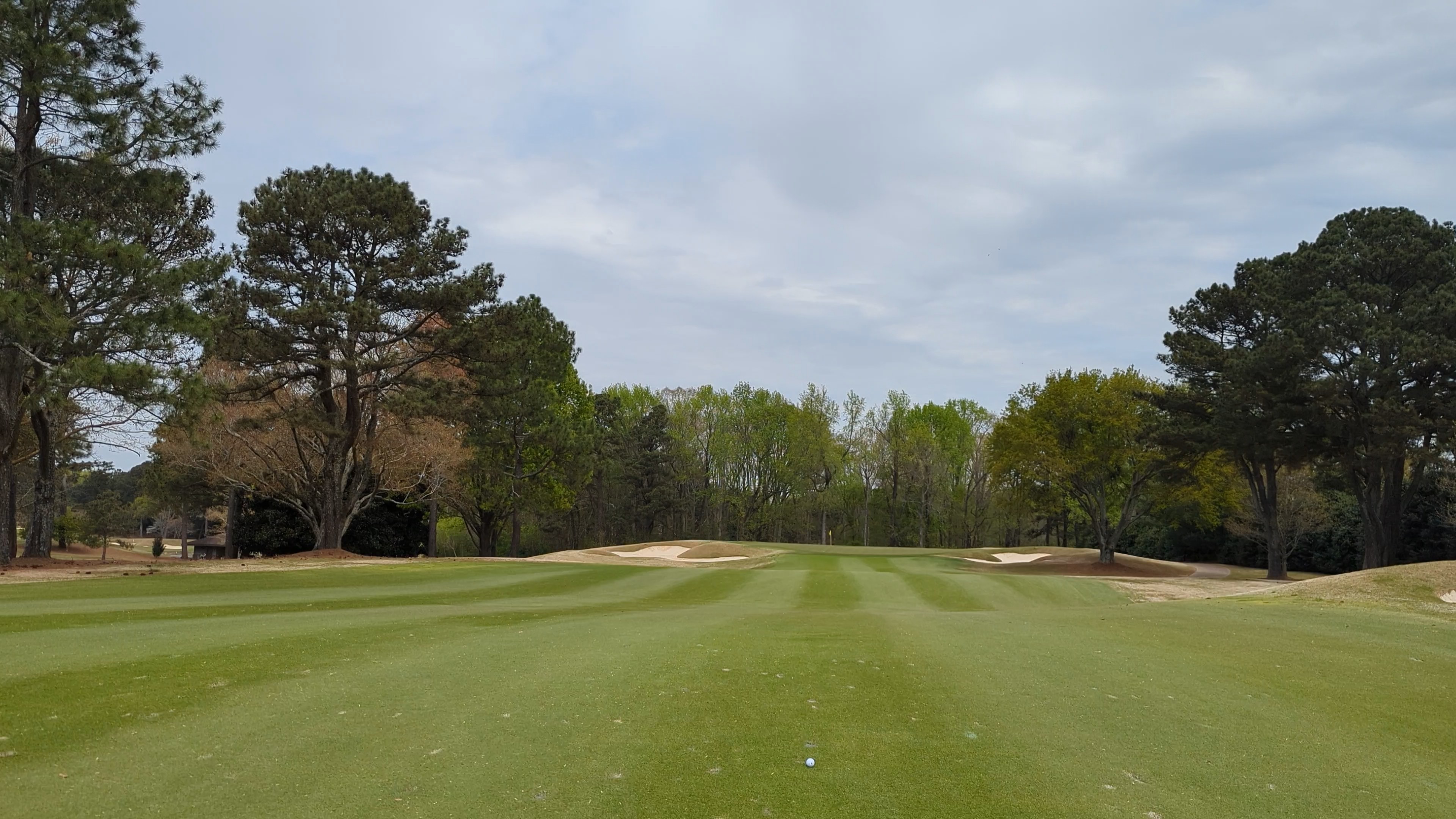
The third hole was a quite enjoyable longer par-4, again protected by fairway bunkers on the right. This drive is tough due to its narrowness, as there only exists about 30 yards between the left tree line and right fairway bunkers. The third is built along a small ridge of the property, and the second shot plays slightly downhill. Two deep greenside bunkers protect the green, with the one on the left being deeper than appearances led on from the fairway, as I would soon find out. After three holes, I started to understand the nature of this golf course a bit better and had to change how I was perceiving it.
In golf, there are typically three schools of design: penal, strategic, and heroic. Every course wants to fall into the strategic category, marked by holes having multiple options and holes forcing a player to think backwards from the pin location. Heroic design forces a player to attempt shots they may not otherwise try (think the eighth at Pebble Beach, or the seventh at Pine Valley); heroic design is considered an offshoot of strategic design.
The other school is penal design, and as I played these holes, I understood the major championship pedigree at the Highlands Course. This course is not about options and heroic carries. This golf course is a test: can you hit it straight, can you hit it long, can you choose proper targets? This is all the course requires; the simple task of good golf. Anything less than straight, long, and properly targeted, and your ball will find a tree, a bunker, a body of water, or worse.
I write a lot about options on a golf course and how that factors into good design, and that is certainly something that can make a golf course great. However, penal design (when properly executed) can make a course both great to play and a great test.
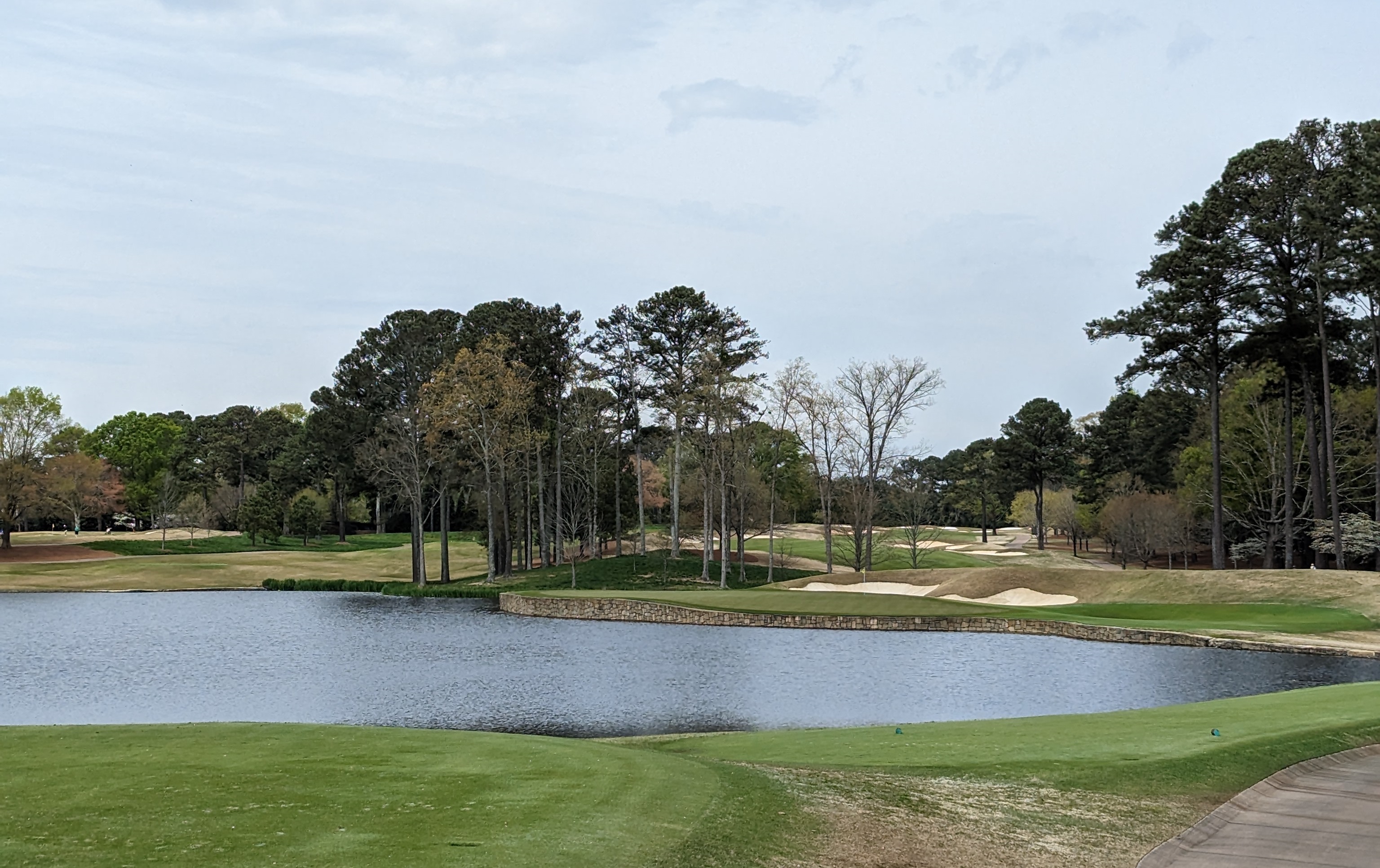
The fourth expands on this penal design philosophy, adding a touch of heroic design, forcing the player to fit a longer iron into a peninsula style green. Different design principles may give you some bailout to the right – as I would find, the bunkers right might almost be worse than the water. The green slopes from right to left and the bunker on the right is very deep – short sided here is simply a bogey at best.
Like mentioned, five is a straightaway par-5 that again just requires length and accuracy in order to succeed.
The original hole at the sixth was also a relatively penal hole, but when Rees Jones redesigned the hole in 2006, the character of this hole changed to add a bit of strategy.

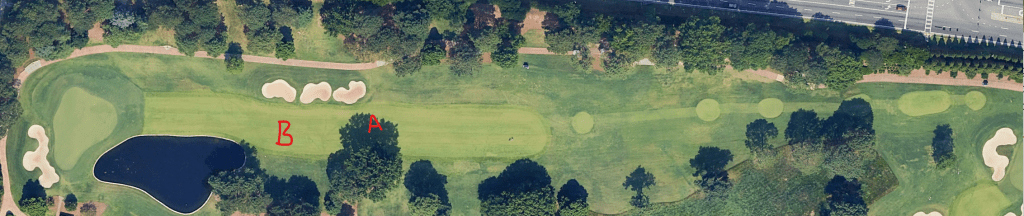
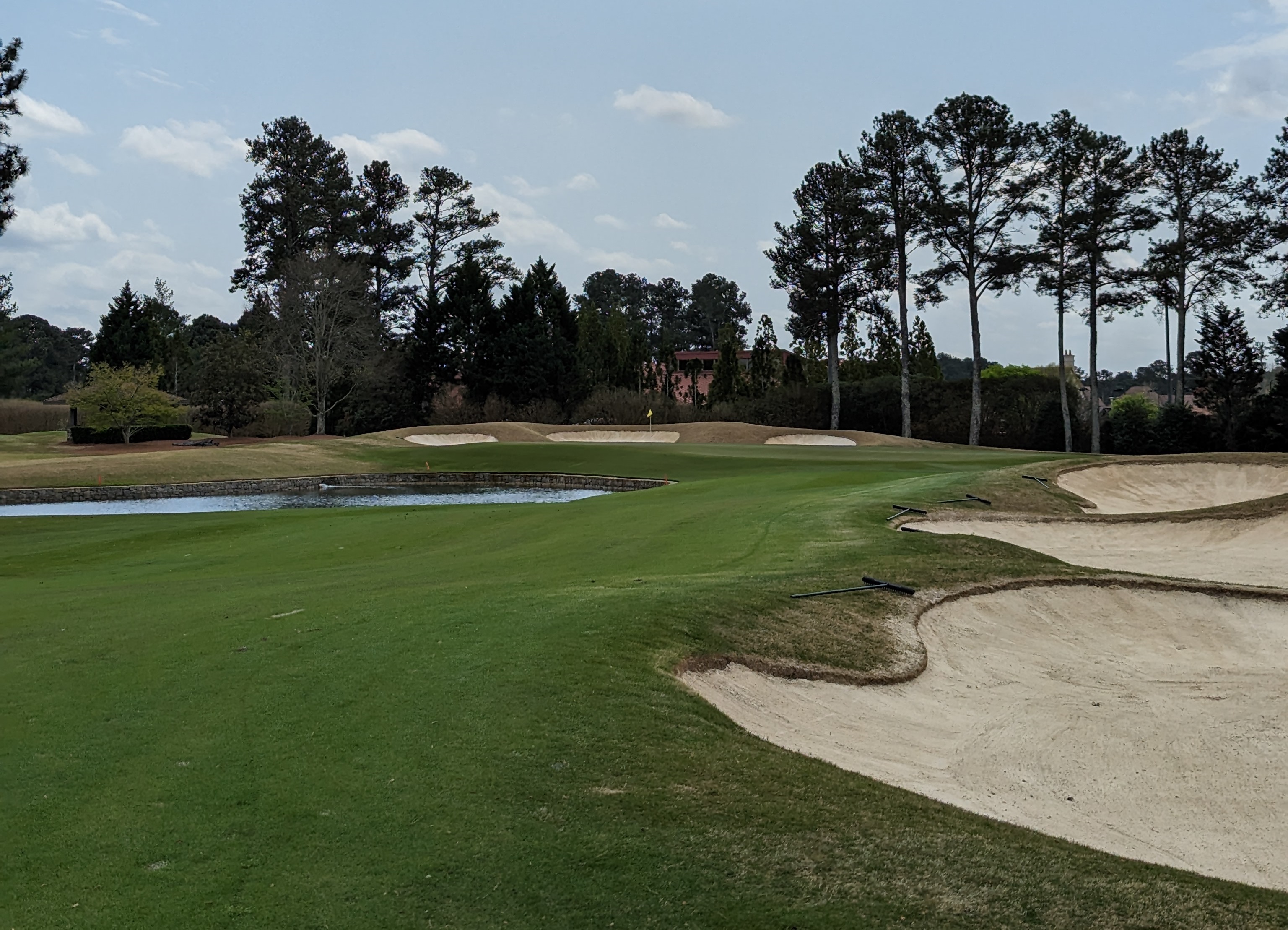
The new hole has two distinct options, as Rees Jones added a pond to the left of the green, reworked the greenside bunkers, and advanced the fairway bunkers. The first option, and one of the few at AAC where this would be an option, is to take something less than driver from the tees to take the lake and bunkers completely out of play. Of course, that sets up a longer shot. The Option B here is driver from the tee, that creates a shorter approach, but certainly brings the bunkers and lake into play. This green was also very tricky, especially on the left side near the lake.
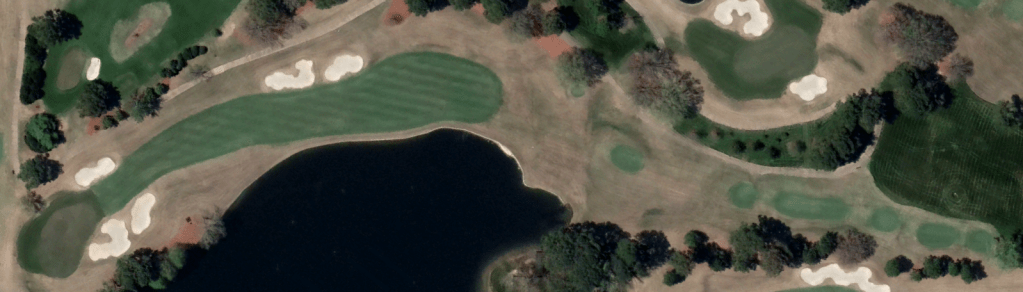
The seventh hole is a mid length par-3 that carries a lake the ends around thirty yards before the green and a large bunker that fills that space. I’d imagine that the seventh plays as one of the easier holes on the front nine and is largely uninteresting despite being a good hole.
It is extremely tough to build uphill holes in golf that have any visual intrigue or are enjoyable to play for the average player, but the eighth hole is one of the better uphill holes I have played.
The eighth works slowly up a slope from the beginning of the fairway to the green, and the well positioned fairway bunkers force a tight drive that has to take on some portion of the lake. This has to be one of the more penal drives on the course: lake, bunker, or 22-yard strip of fairway.
The ninth is a great mid-length par-4 that works across a ridge running perpendicular to the hole. The ninth also has a midline bunker that fronts the green, complicating the approach shot; however, the green may be one of the largest on this side, despite being heavily fortified. Again, this hole is penal, both a missed drive or a missed approach will be in a deep bunker, making for an exacting test to finish off the front nine. The clubhouse loom in the background over the trees watching you finish up your front side.

Making the Turn
The tenth tee is almost directly beside the first, just in case you needed some added pressure on what is one of the more confusing drives on the front nine. This mid-length par-4 doglegs right, but it seems as if the dogleg occurs too early in the hole, forcing the player to either lay back off the tee, or try to hit a large fade with driver. Those that lay back find themselves safely in the fairway, but with a long way to go after clearing the dogleg – something in the area of 180 yards. The green is a tricky surface with a deep bunker quartering the front left of the green.
The eleventh hole is the best hole on the course and maybe the best hole in Atlanta (albeit, I haven’t played a lot in Atlanta). But realistically, how could a hole be better? First, the hole presents a few strategy options off the tee, as the tee shot (and the entire hole) plays aggressively down the side of a hill.
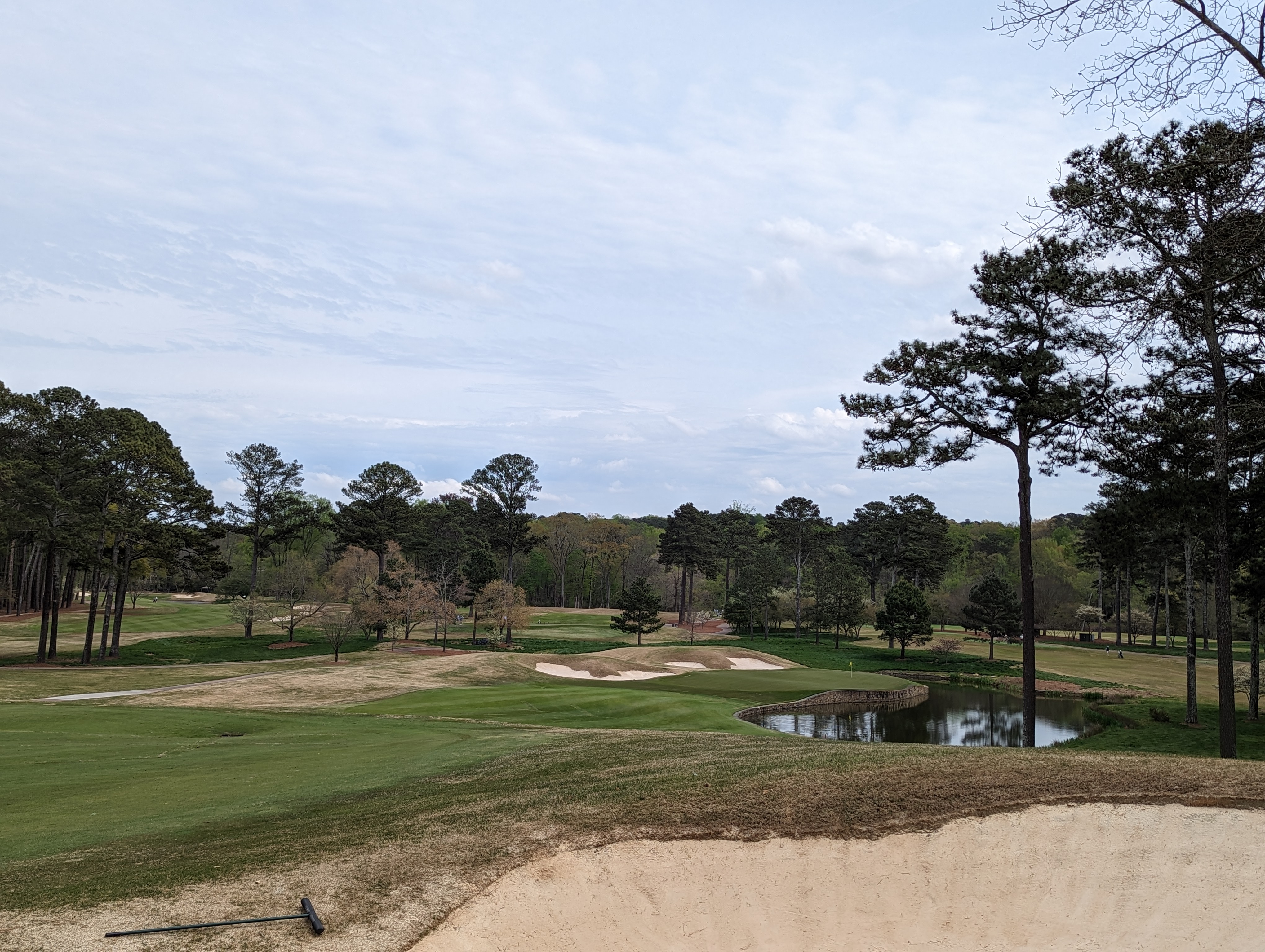
Finding the proper club to gauge the carry and rollout between two deep bunkers flanking either side of the fairway approximately 280-downhill-yards from the tee boxes. The hole then proceeds to drop again to a green protected by a small catch pond on the right and two deep bunkers on the left. Predictably, the green slopes left to right towards the water and is bisected by a small ridge. This is a fantastic hole that provides all three schools of design on one hole: it is penal to a miss, it has multiple options and lines on how to play the hole, and the elevated shot from the fairway over the protruding pond provides the great shot a heroic moment to a pin on the right of the green.
The twelfth is a scoring opportunity as a shorter par-5 that plays a bit downhill. The drive is narrow, and the hole doglegs late, meaning your second shot may have to be shaped to reach the green. Complicating that second shot, another small catch pond quarters the right front of the green. However, pull off two reasonable shots here, and a player might have a chance for birdie.
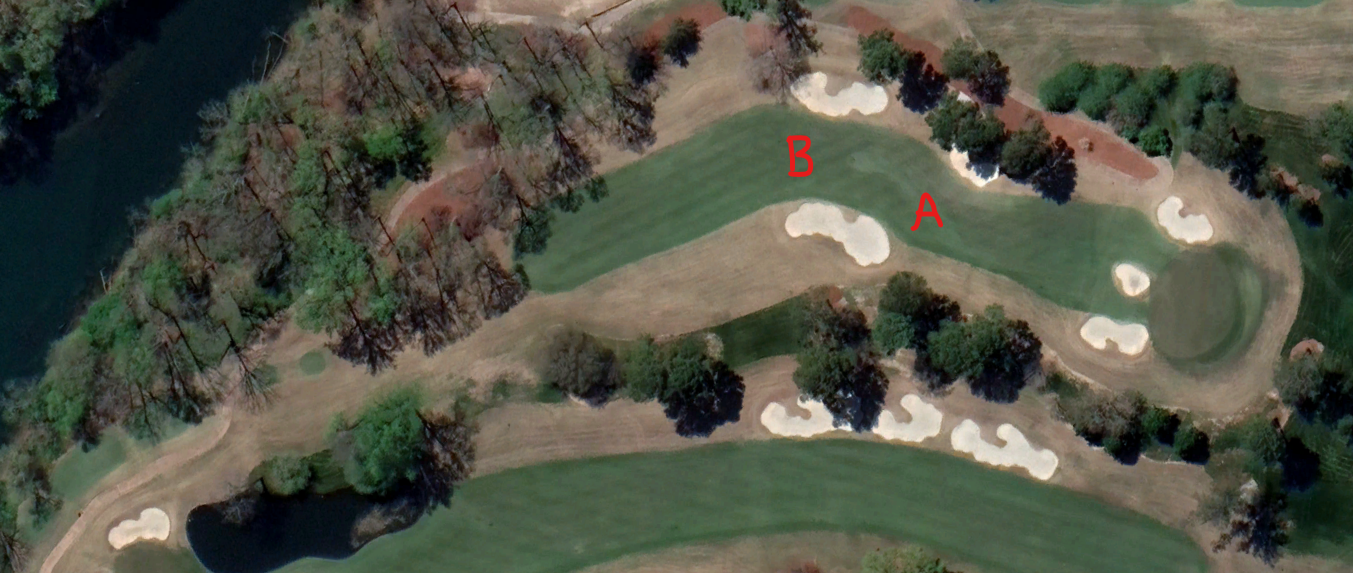
The thirteenth is straight out of the strategy school of design and presents a simple option. Option A to carry the bunker on the right, something around 270 yards to carry depending on the tee. Option B to layup, leaving a more difficult approach into the green that is aggressive. The right side of this green really falls off towards that tree line which plays like a barranca would in other parts of the world. The lion’s mouth bunker in front of the green makes this approach solely aerial in nature.

The fourteenth hole is a great hole that works back up the hill that the eleventh comes down, and provides one of two elevated greens over the next three holes. Reverting to a more penal design, this fairway squeezes to just 27 yards between the left and right bunkers in the fairway, which are deep and inhospitable. The second shot is pretty straight-forward to the elevated green, where the greenside bunkers serve more as visual clutter than physical fortification. There is space to miss around this green, but most of it will be below the green’s surface.
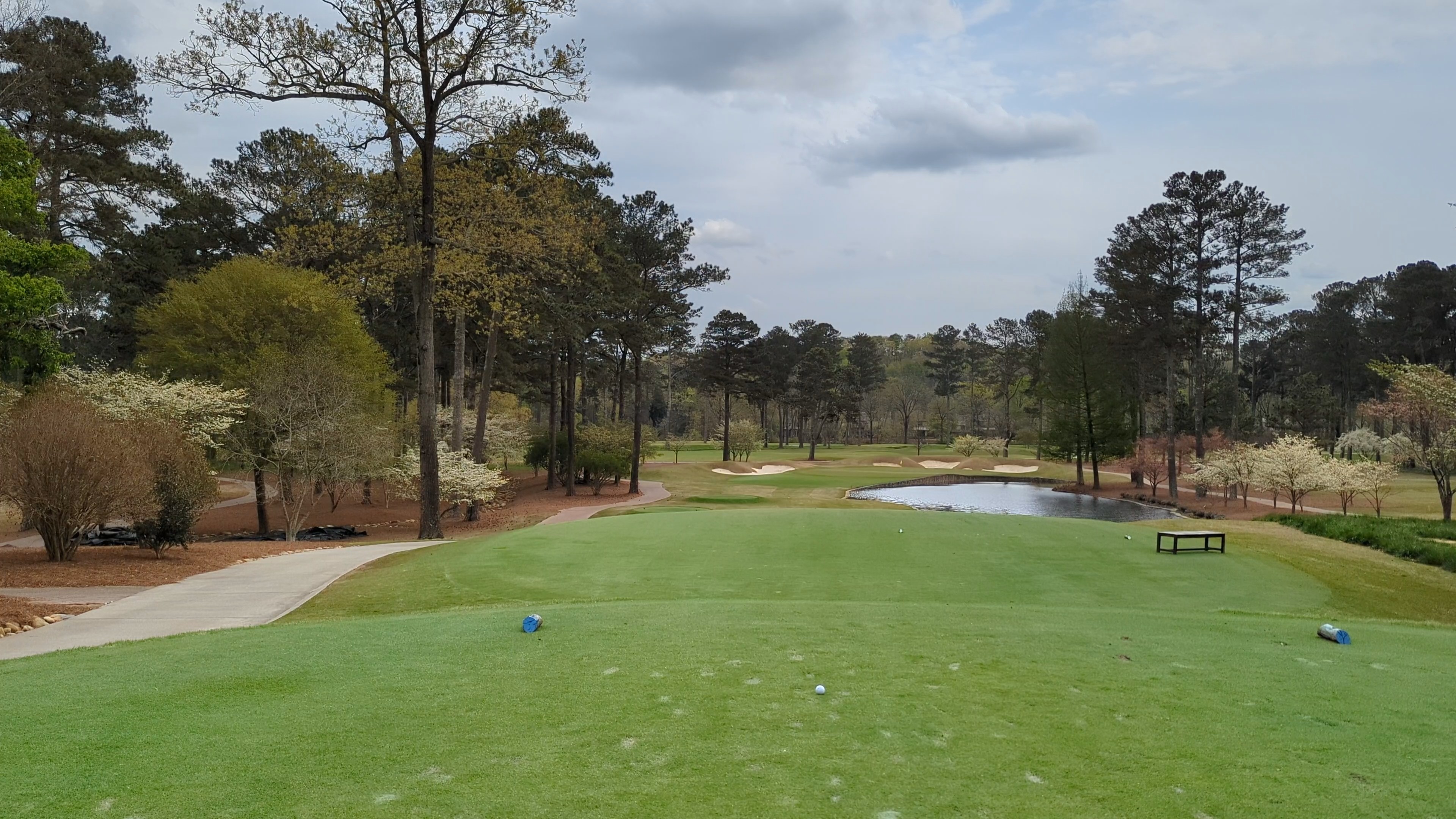
The fifteenth, a famously difficult par-3, is a long, downhill par-3 that can play up to 260 yards, although at that length it plays significantly downhill. Nonetheless, the hole is protected on the right by a pond and on the other sides by two deep bunkers. The fifteenth is an gorgeous hole viewed from the elevated tee box and is a proper challenge regardless of the tee box chosen.

The sixteenth may be my favorite hole on the course. Again, it is so difficult to design an interesting uphill hole, but the sixteenth accomplishes climbing the same hill which the fifteenth falls. The tee shot is one of the easier tee shots, allowing for some bailout room to the left, but the second shot provides no visibility of the putting surface. The green is also very tough, pitched from right to left. This may be my favorite just due to the beauty of this uphill hole.
So picture this, you have two holes left to win a major championship. You just finished successfully navigating a 260-yard downhill par-3 on the fifteenth, and you are trying to get it into the clubhouse to secure your first victory. You step up on the tee and are greeted with this view.
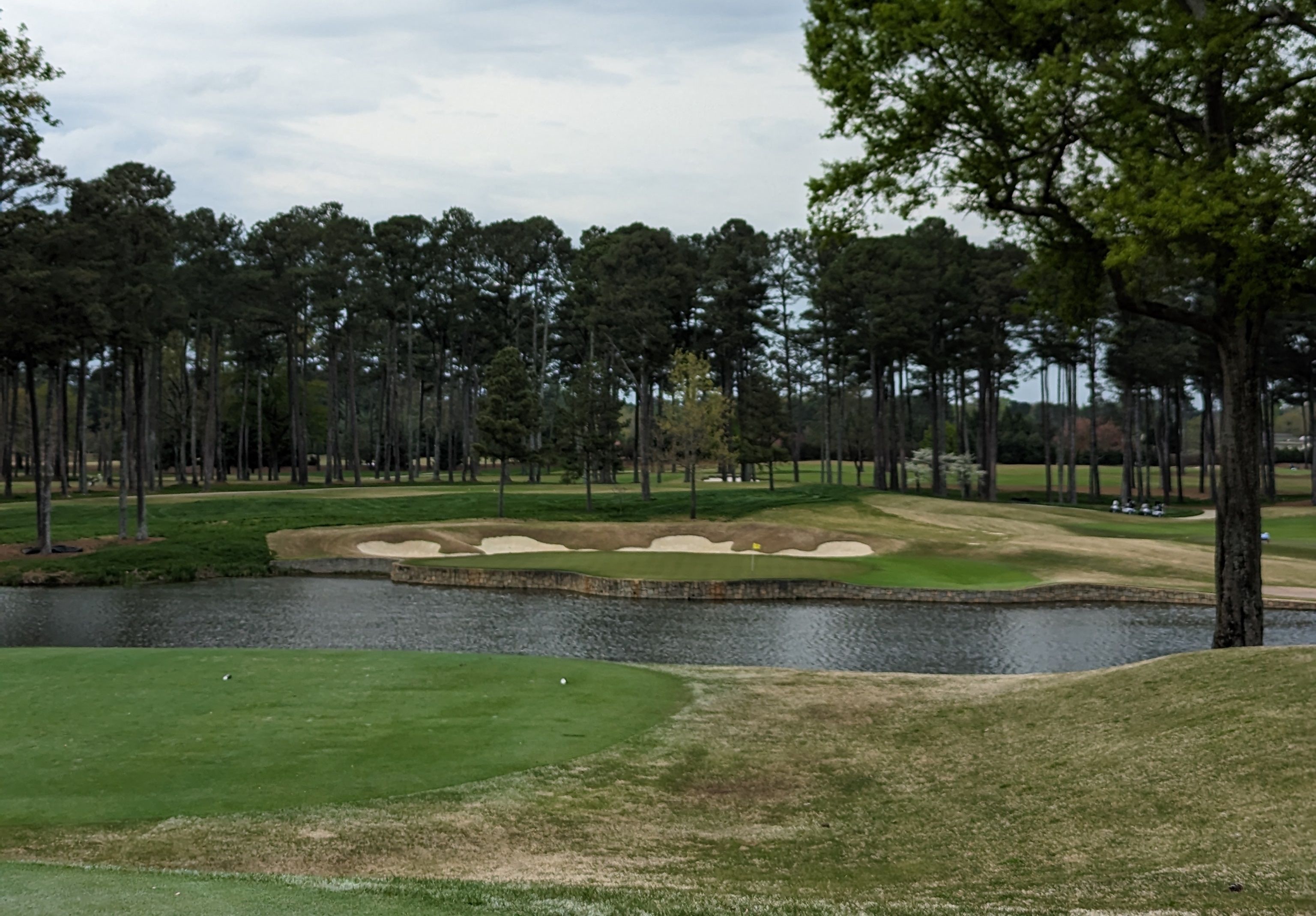
The seventeenth is a 210-yard par-3, a bit downhill and all carry. The slightest miss on the club’s face is a water ball. On a firm day, anything but a nice high long iron is destined for the deep back bunker. I mean, this is just a proper major championship set of par-3s on the back nine, that require nothing less than exacting precision in order to survive.

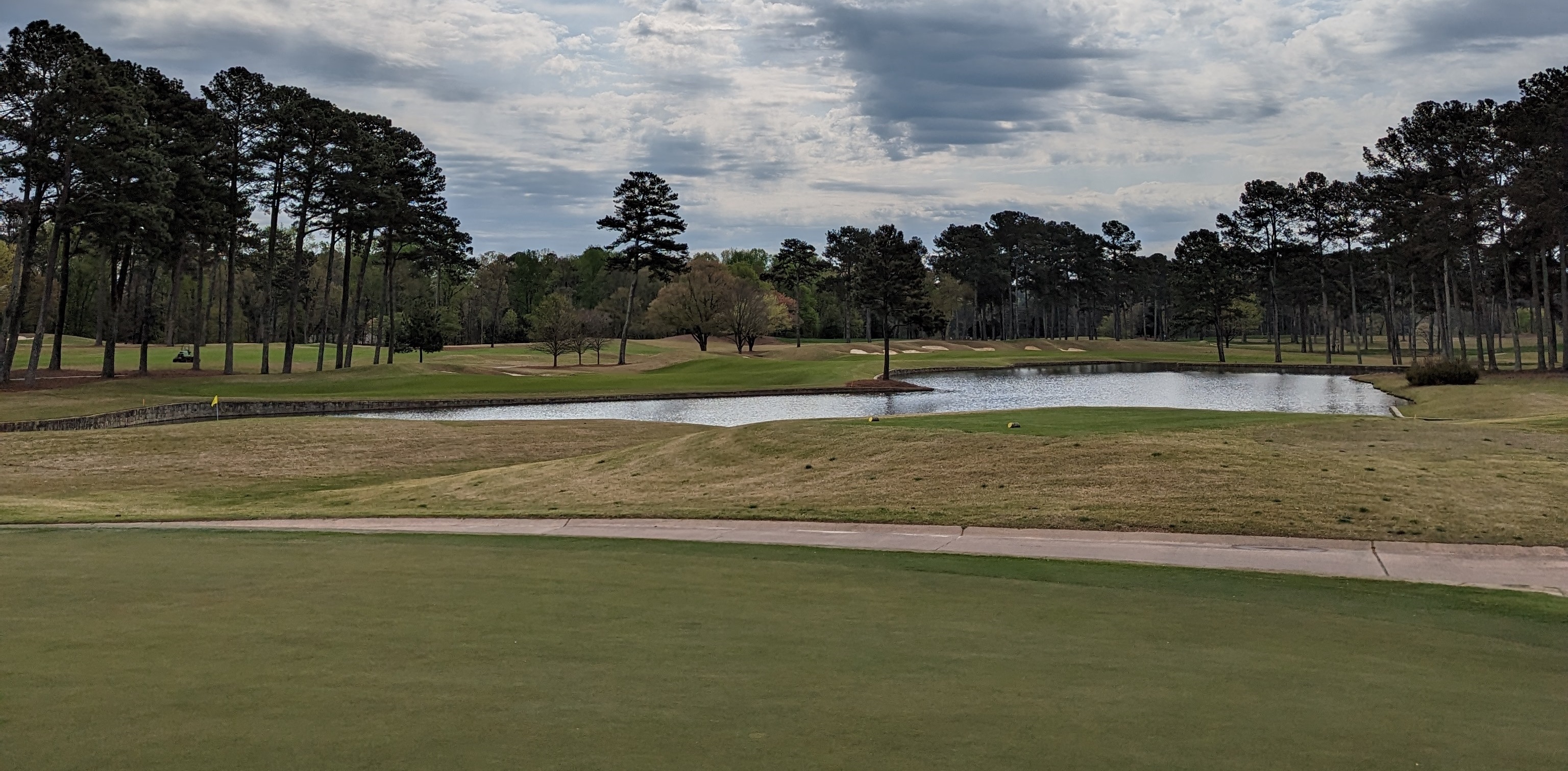
Like any good course that hosts professional golf tournaments, the eighteenth provides risk and reward. The mid-length par-5 is a reachable one, provided your drive is in the fairway rather than one of the four deep, large bunkers that dot the right side of the fairway. The second shot seems to be designed to be a tough carry over a pond that crosses in front of the green. The green looks impossibly small on the other side of that carry. That crossing lake presents a great deterrence to a leader, and an opportunity to a trailing player, and provides the space for a major championship, a local tournament, or a match among friends to be won or lost.
Final Thoughts
I really enjoyed Atlanta Athletic Club, from the bag drop employee that I had too long a conversation with, to my host, to the starter, everyone was incredibly friendly. The vibe was old-fashioned southern hospitality at one of the South’s finest golf clubs. While I’m not usually a fan of penal golf design, the visual intrigue that this course provides, as well as the fairness of the course design made me a fan. It isn’t a course of gimmicks and tricks; it is just a course that asks, or requires, you to play good golf. There’s something simple to that concept, and its a vision that more designers working on new courses should incorporate in their designs. At its core, the game is simple: ball, field, hole; many newer designs lose this simplicity in the search for uniqueness. The maturity of the Highlands Course is evident: it exudes design simplicity at its core, it does not over-complicate for the sake of complication, and provides an exacting test that is fair and straightforward, but yet incredibly difficult.
F1C’s Final Rating:
Shot Options: 8
Challenge: 10
Layout Variety: 7
Distinctiveness: 8
Aesthetics: 7
Conditioning: 9
Character: 8
Fun: 9
Total: 66/80
Read More: How We Rate Courses
Rating Scale Details
> 70: Top-50 U.S.
65-70: Top-200 U.S.,
60-65: Best-in-State List
57-60: Best-in-state List Contender
53-57: Very Good
48-53: Good
40-48: Average
> 40: Poor
 First 1000 Courses
Leave a comment