

This GreyStone Golf Club course review is based on numerous rounds played between 2019 and 2023.
GreyStone Golf Club is a public course in Dickson, TN (a small town just west of Nashville, TN). The maximum green fee in peak season $80.
F1C’s Final Score: 54/80 (Very Good)
Read More: How We Rate Courses
Where to Stay -> Check out F1C’s Nashville, TN Golf Travel Guide
Value. The word can have two distinct connotations, one positive and one negative. Positively used, the word value can imply that you are getting more worth for your dollar than deserved or expected. Negatively used, it can mean that the product or service is inferior or cut-rate, sacrificing quality for the sake of price. Often, the word when applied to a product or service ends up meaning both: a product that sells for less, is inferior in some measurable way, but is priced so competitively that the difference in product’s quality does not warrant the difference in price one would have to pay to acquire different, higher priced alternative.
That’s GreyStone. It is a store-brand, value alternative to high-priced Nashville public golf. Being in Dickson, TN about 45-minutes outside of Nashville, GreyStone naturally has to lower their rates in order to attract players that live outside of Dickson to make the trip. The distance from affluent Nashville is GreyStone’s greatest obstacle, but they’ve found the perfect solution to maximize their business model. Instead of being a first-class public course, GreyStone is intentionally aiming to be a value-brand of first-class public golf courses – and it does it well. Sometimes value brands are almost as good as the name brand.
GreyStone is a Mark McCumber design that has hosted multiple Tennessee State Opens and other higher-profile competitive golf tournaments in recent memory. From a conditioning standpoint, the course can be a touch spotty, but is normally in above-average shape. GreyStone still has bentgrass greens, which in this area of the world were dominant for decades, but now most courses have switched or are actively switching to newer strains of bermudagrass (also known as concrete) for their putting surfaces. The reason: Nashville summers are hot and bentgrass doesn’t like hot. To keep the bentgrass alive, it must be watered heavily, creating soft greens that better players tend to chew up. GreyStone is a golfer’s spot and has a tradition of having many good players that are members or visit often. This means that the bentgrass greens become a bit dimpled in the summer, as better players leave crater sized ball mark repairs in soft bentgrass greens. Some of the players even repair their ball marks! I have no doubt that GreyStone will eventually change over to bermuda a-la-every other course in the area, but for now – still bentgrass.
GreyStone has a large practice putting green and a nice range on which to warm up. The clubhouse is a touch on the smaller side, but has plenty of room for a small pro shop, a grille, and some restrooms. The clubhouse sits on one of the highest points on the property and overlooks most of the course.
So, immediately upon arriving on the property, you are presented with a very picture-worthy moment, which is nice. After that picture and a warm up, it is time for some golf, and GreyStone has an interesting test that awaits on either the first or the tenth tee. I say “either” because it seems that about 50% of the time that I play GreyStone, they are starting groups on the tenth rather than the first. The first and tenth have similar characteristics though, so that’s quite alright.
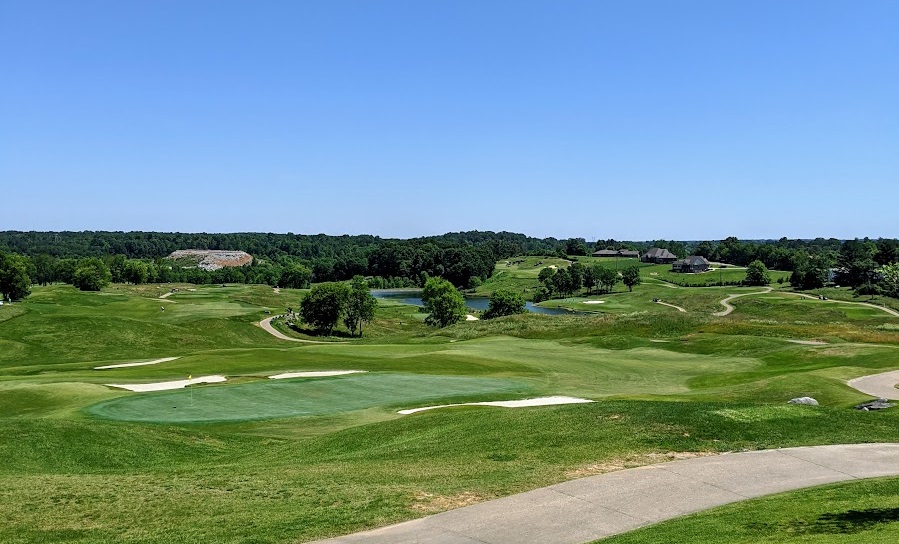
The First Tee
The first hole, like the tenth, is an aggressive way to start a round of golf. What goes up must come down, and as I have mentioned, the clubhouse is the highest point on the golf course, allowing for such a great view. The first and the tenth, accordingly, must go downhill to reach the rest of the golf course, and downhill they both definitely go.
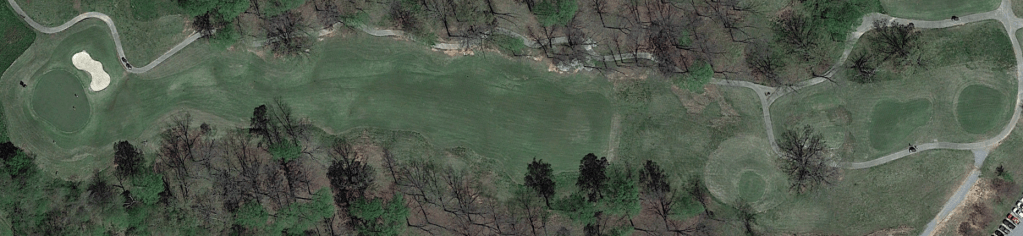
The first hole is a straight-away par-4 that is just gently downhill until the landing area for a driver. The hole rapidly drops inside 150 yards down 40-50 feet, but the fairway never becomes disconnected from the hole. The hole is a bit tough for someone who fades the ball, as the right tree line is severely downhill, and a ball right of the cart path will bounce 20-30 yards further right in the trees. Left of the fairway, while uphill, is a dense forested area and a ball left is likely three from the tee.
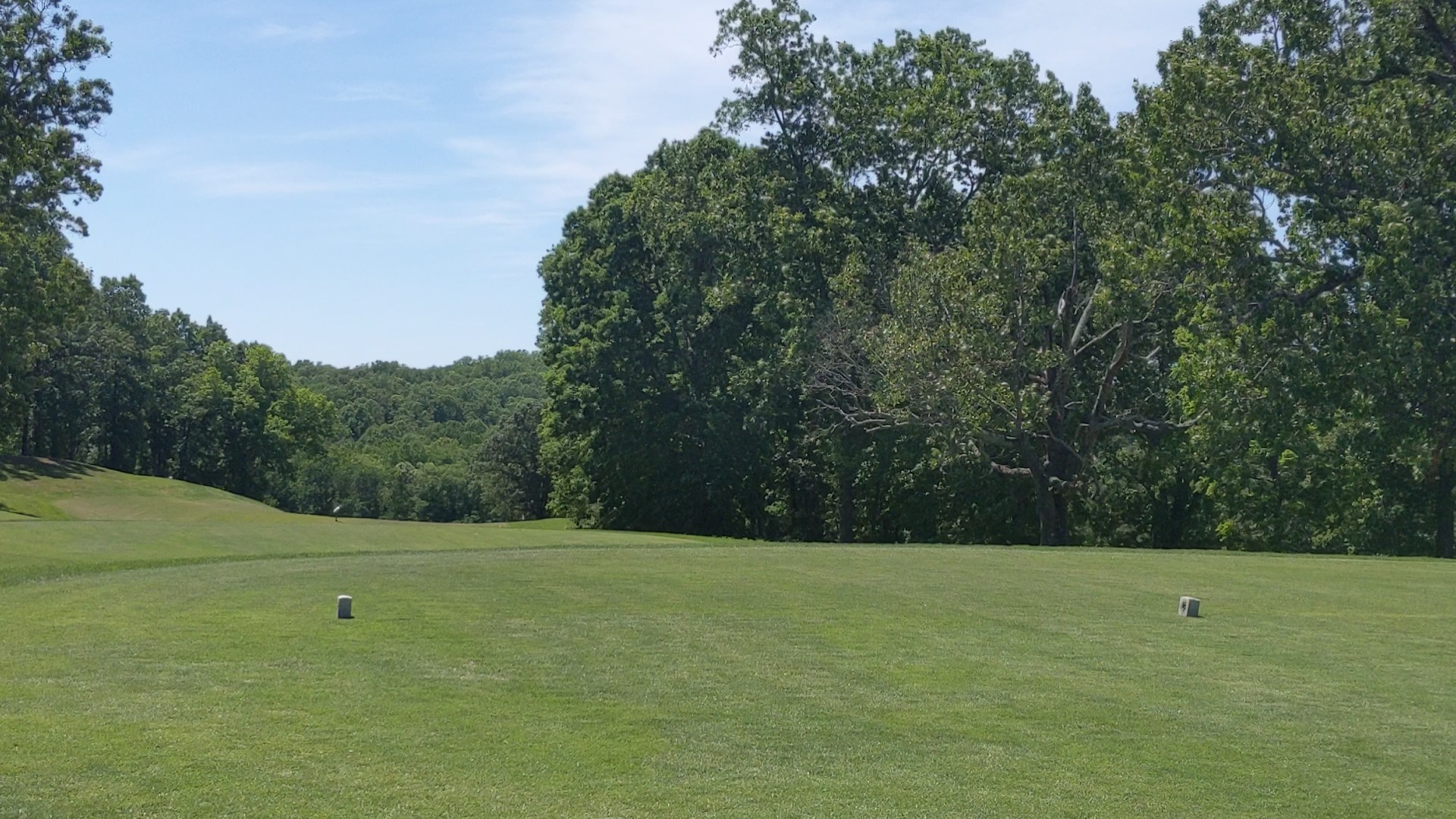
Of course, with as much elevation that is lost on the approach, dialing up the right distance is difficult and over the green is also a lost ball, as it is severely downhill behind the green. This can make for a fun starting hole that yields a reasonable chance at birdie, but it can quickly turn sour should you miss off the tee.
The second hole is a largely straight away par-5, with a tricky decision on the second shot. The tee shot is pretty straight forward – wide fairway, infinite bailout room right, tight tree-line left. The second shot after a well struck drive presents a decision, as it will leave about 230-260 to the green.
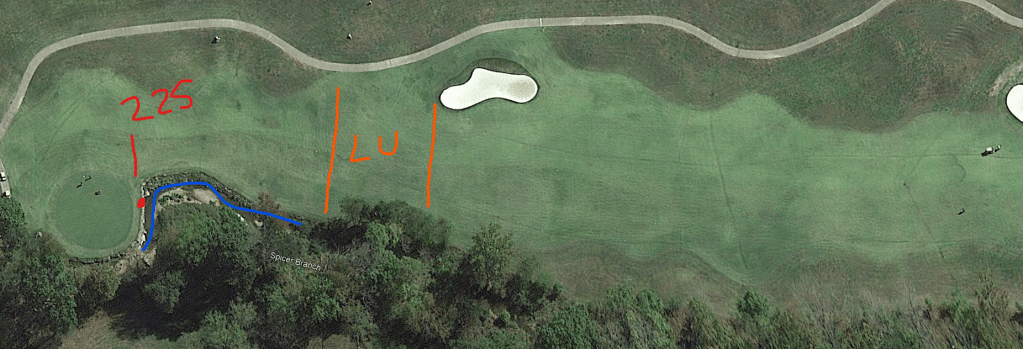
If you go for it, you’ll likely have more than 225 yards to cover GreyStone’s first rock wall that serves as a retaining wall for the second green. A small creek fronts that rock wall that extends for the bit of the fairway preceding the green. A player in the fairway has three options: (1) go for the green, which is all carry on the line of the green, (2) go directly to the right, parallel with the green in the fairway, or (3) layup into the small layup area between the fairway bunker and the creek. There isn’t much room for the layup to have zero risk; it is very likely that the player will have to take on some portion of the fairway bunker or the stream in order to layup, whether option (2) or option (3) is chosen. As you know, we like option golf at F1C, and this is a good par-5.
The third hole is a relatively uninteresting mid-length par-3 before the course turns to the par-4 fourth hole which runs parallel to the second hole in the opposite direction.
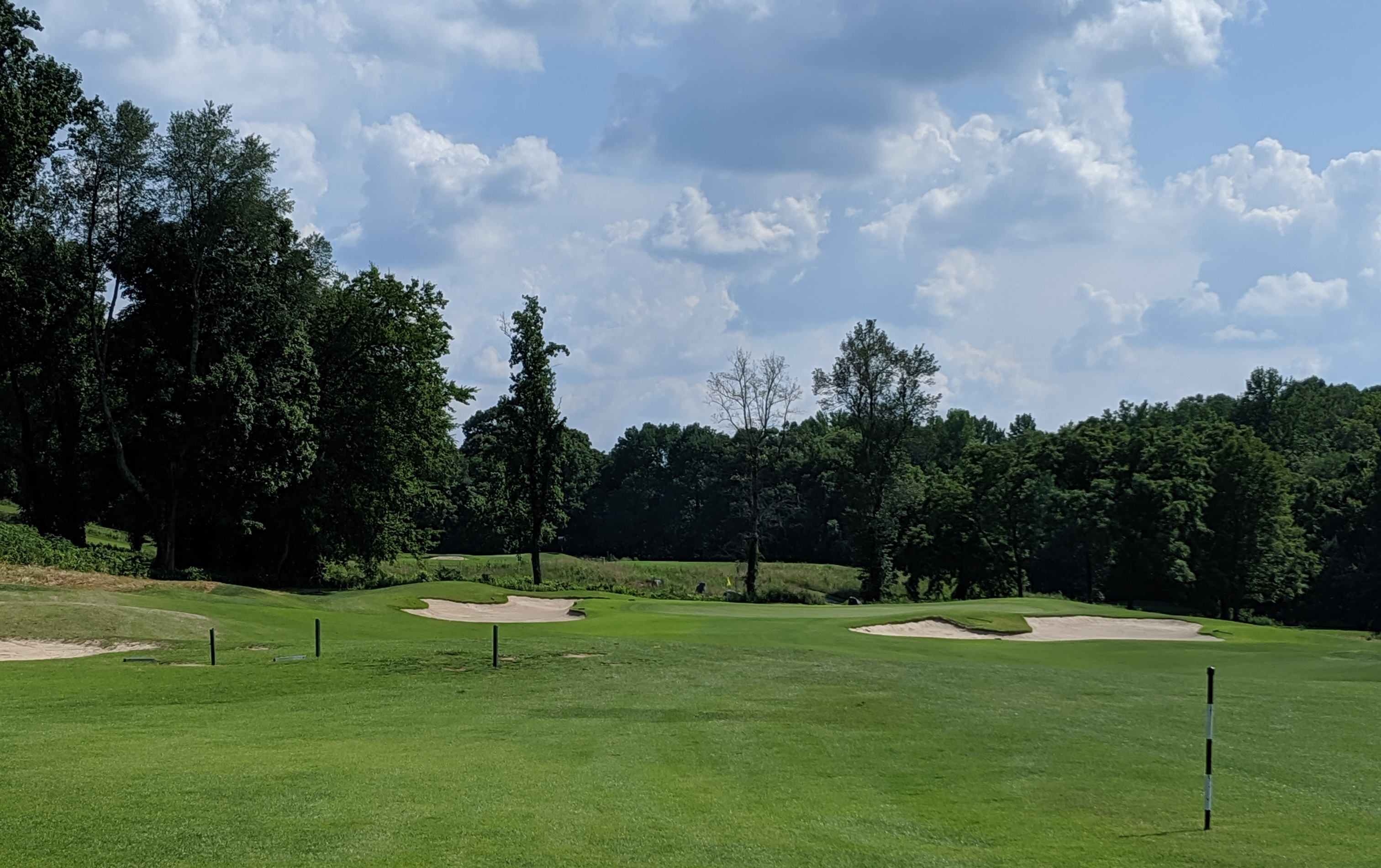
The fourth has a two tiered fairway: the second tier is just a touch lower than the first tier, separated by a small slope. Where the second hole runs parallel right of the second, the fourth’s challenge is not being distracted by the open space to the right off the tee. A flat, easy second shot awaits on the fourth from the fairway, but there are large mounds of uneven rough in the open space to the right of the fairway and the approach is complicated by a bad angle over the deep greenside bunker.
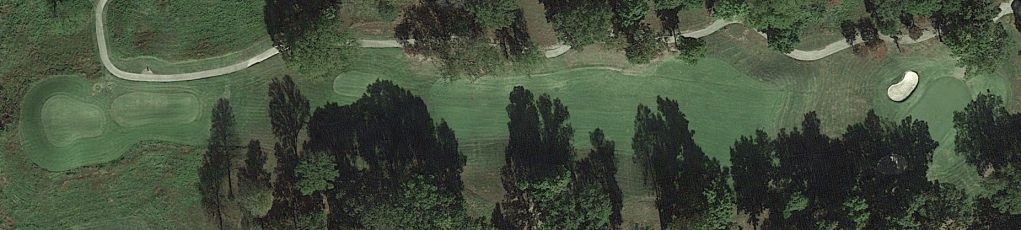
The fifth hole is a tricky hole that is very narrow; the tee shot plays largely uphill. The fairway runs out around 265 yards, and after the runout, a steep 40-yard trench of rough seperates the fairway and the green which sits on the prepuce of the next hillside. The hole is tricky because there are only about 40-yards between the tree line, and any layup club (less than 3-wood) off the tee, will stop on the uphill fairway complicating the sight line to the green. This hole runs parallel to the first and plays up the same hill that the first comes down.
The sixth is an uninteresting longer par-3, which is the real knock on this front nine. Both of the par-3 holes are essentially characterless and option-less holes. The seventh, however, may be the best par-4 on the course.
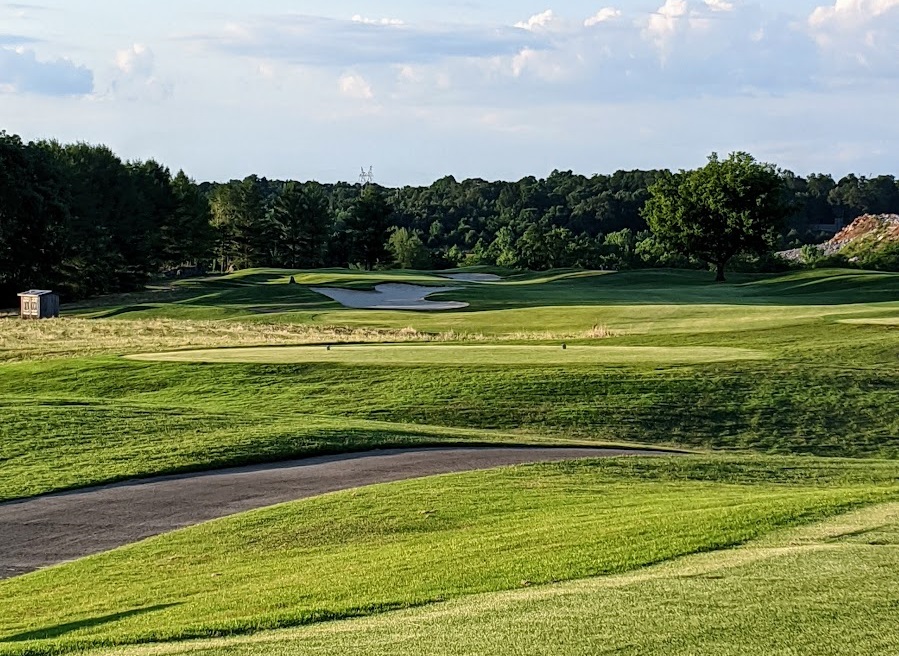
These golden hour pictures probably make the hole look prettier than it actually is, but the large fairway bunker on this long par-4 makes an otherwise straight par-4 into a hole that plays a bit like a dogleg-left around the large bunker. The fairway bunker is about 285 yards to clear, so only the longest players can take a line that involves the bunker considering the carry required. Most players will play comfortably between the bunker and the tree, which will leave a 170 yards into a green protected by a deep right hand bunker, and the second rock wall on the course to the left of the green that has chewed up and spit out many pulled approach shots.
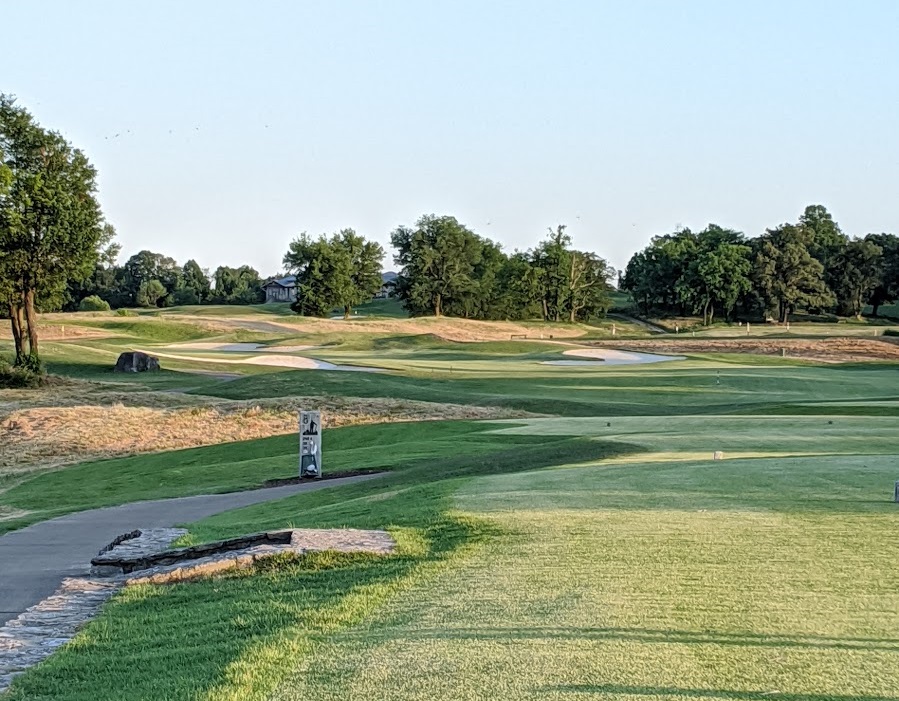
The eight is a shorter par-4 that runs parallel to the eighth and is GreyStone’s first good strategy par-4.
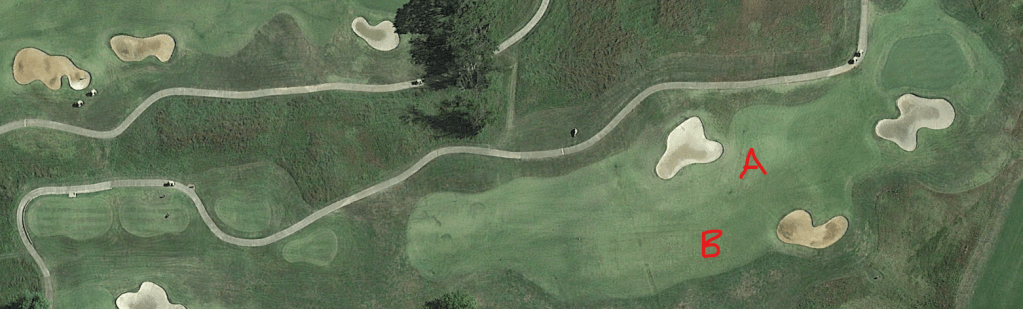
The left fairway bunker is about 270 yards to carry, but the right fairway bunker is only 285 yards to reach. This leaves the player with a few options, as that is right in the landing area for most players from their respective tees.
- Option A: Driver off the tee. A risky proposition, because a ball a bit right of target will find the awkward fairway bunker on the right leaving an uncomfortable 80-or-so yards to the green from the sand. A ball left of target will find the weeds, and a ball not well struck may find the left bunker if not carried. The hole plays a touch uphill as well, so the carry is longer than the yardage. It is a tough shot, and some would say, for little reward, as the best case scenario is a 75-yard half wedge to the green.
- Option B: Something less than driver behind the right bunker: B is a safer play, but leaves a worse angle over the greenside bunker from a longer distance, particularly to pins on the back right portion of the green. The amount of landing area becomes really squeezed from this angle, requiring a more precise approach shot from a longer distance than A of about 110-120 yards.
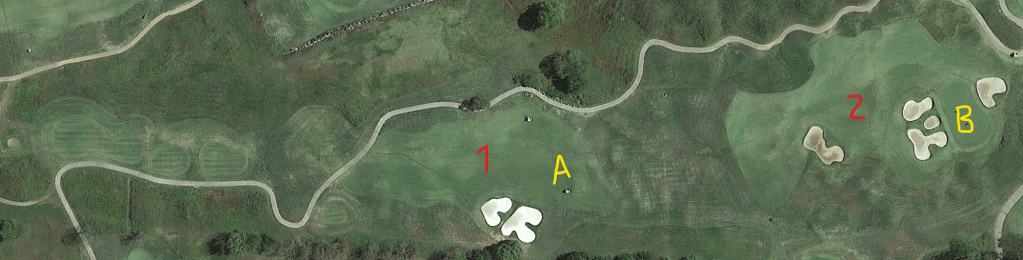
The ninth doesn’t let up on strategy, and is the best hole on the course. The strongest of this great five hole stretch from the seventh through the eleventh, this shorter par-5 requires a precise tee-shot and will reward such with plenty of options and a real chance to go for this green in two. The hole plays back uphill and provides a great view of the clubhouse.
- The numbered option is a tough choice, because it requires something less than driver off the tee on a par-5 (already tough to do), and the landing area is squeezed by the two fairway bunkers. The second shot has to carry a cross fairway bunker and stop before the greenside bunkers and doesn’t represent a risk free layup.
- The lettered option represents a driver off the tee most likely, but its a soft driver, as the fairway runs out at 280 before a 70-yard steep trench of rough before the second fairway. Left of the drive is a lost ball and right is the driving range. Its a tough drive into an area about 60 yards wide. However, if you pull it off, you should have around 210 yards uphill to reach the front of the putting surface and clear the greenside bunkers. A risk off the tee, and a risk on the approach shot considering the depth of the bunkers that front the green.

Making the Turn
The tenth hole goes from the clubhouse back down to the majority of the golf course, as the tenth drops off right from the tee as a dogleg-left par-4. Most players will take something less than driver, and figuring out the appropriate line to take off the tee is perhaps the toughest part of this shorter par-4.
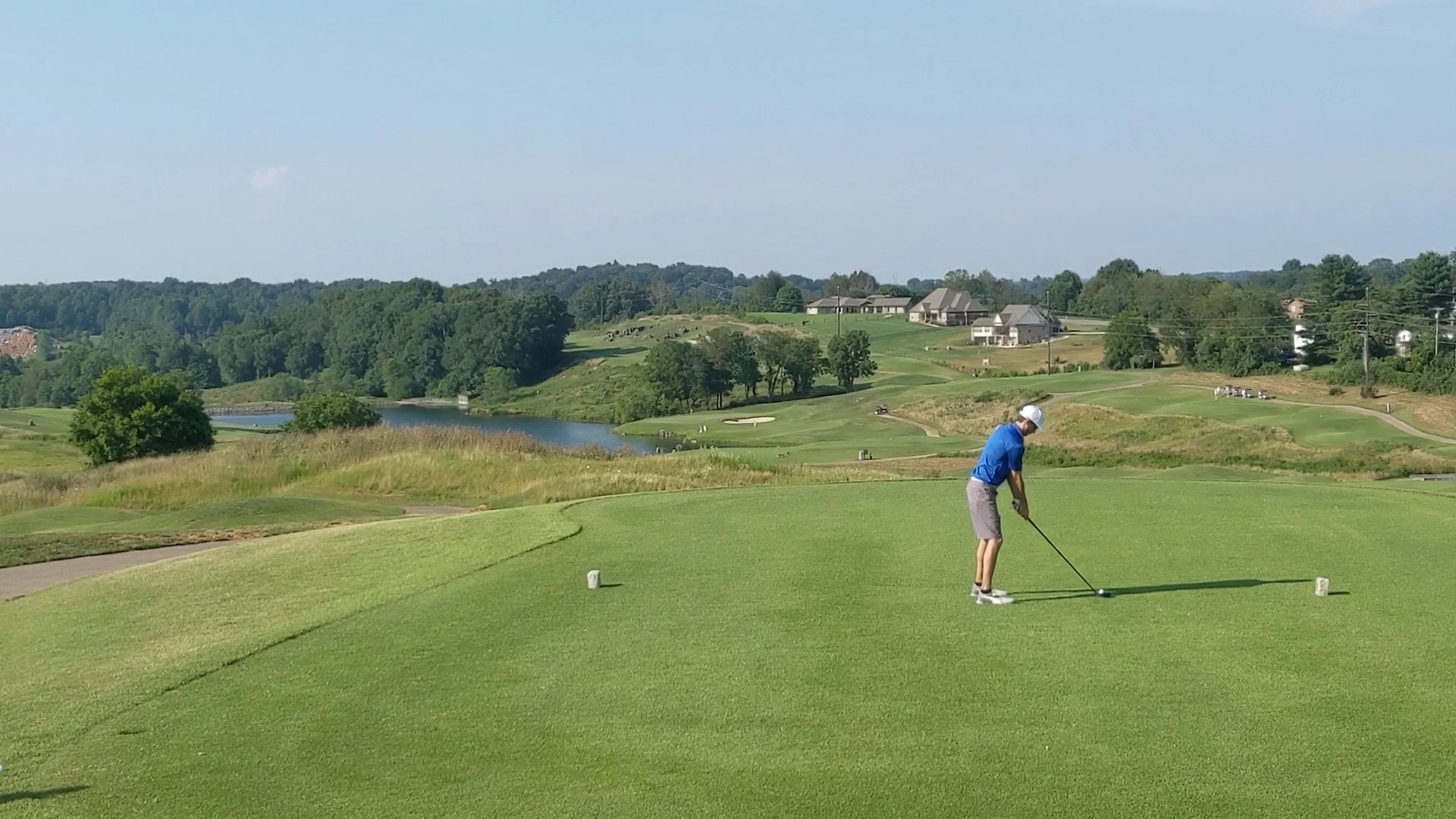
If you were aiming at the green that appears to be straight ahead, you wouldn’t be the first person that had mistaken the eleventh green for the tenth. The tenth is actually around the bend to the left, and to the left of the green lies the third of the grey rock walls for which GreyStone is named.
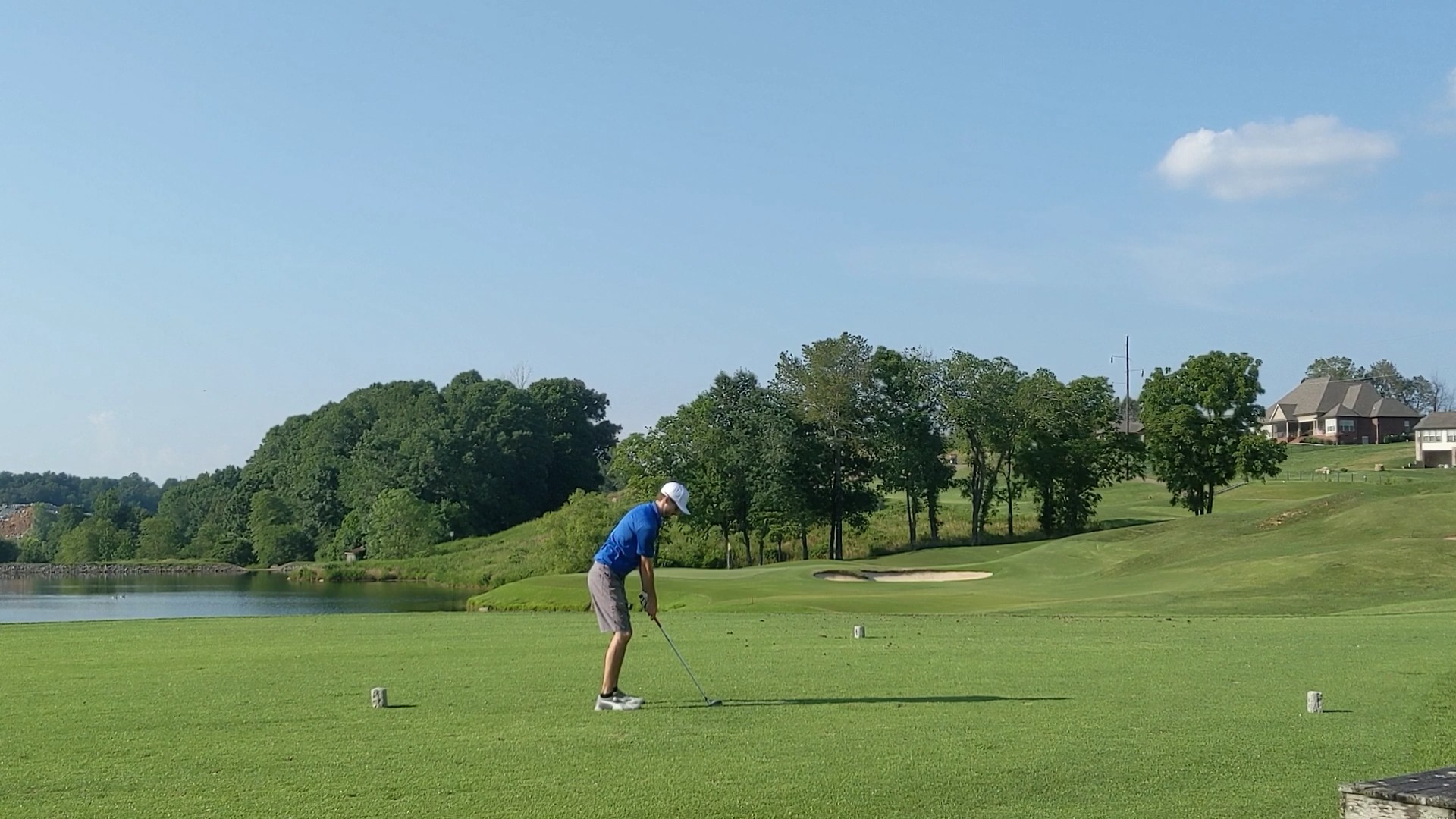
The eleventh hole is actually a mid-length par-3 that starts at the base of the hill and plays across the pond to a peninsula green. The back nine’s par-3s are much better than the front nine’s, and while this is an often seen par-3 template, the hole provides some variety as a hole built around a water hazard, which the front-nine is basically completely devoid.
The twelfth is an interesting hole and largely disliked among my group, a straightaway par-5 from the top of the hill that goes down-up-down like a roller coaster, making the play into the green essentially blind from all but the shortest approaches. To complicate matters, there are a number of exposed grey stones that break this fairway in half, and make any low approach shot from the right half of the fairway relatively dangerous. For the thrill seekers among us, this is a great hole; but, for average golfers, this is easily the worst hole on the course. If I bought this course, I’d begin the redevelopment the twelfth on the first day of my ownership.
The thirteenth is an interesting hole, and probably the last interesting hole in the development of this course. Reconstructing McCumber’s thoughts, I think he largely knew where the routing would lead him for the sixteenth, seventeenth and eighteenth holes – those were somewhat obvious based on the lay of the land. Thirteen through fifteen were likely tougher to conceptualize and design, and I think McCumber did a great job on the thirteenth and a below average job on fourteenth and the fifteenth.
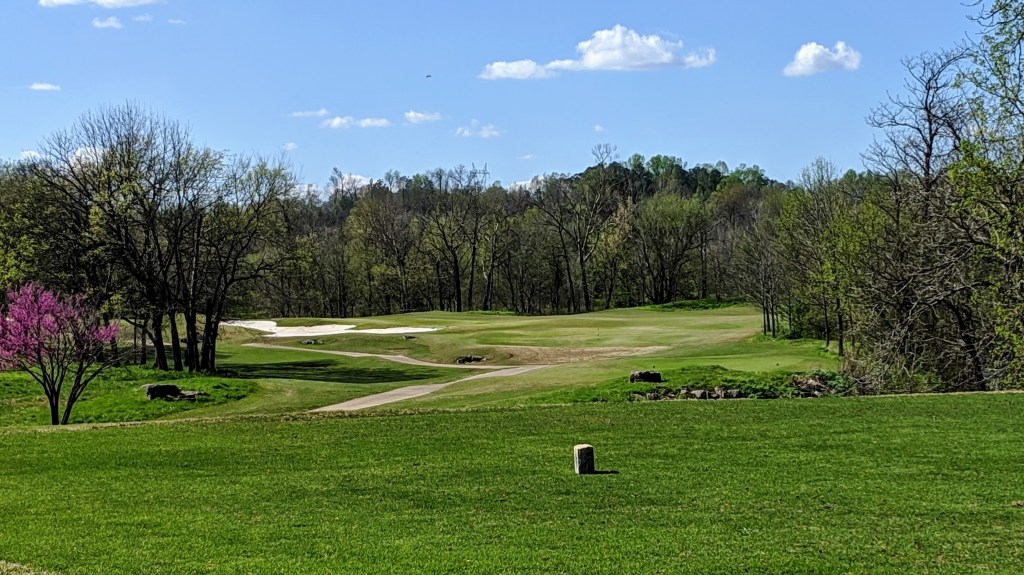
The thirteenth is a shorter dogleg-left par-3 that doglegs around a singular large bunker. The hole presents two distinct options, a driver that takes on more of the fairway bunker and also presents the option of carrying the ball too far into the wooded area behind the hole. A player could take a more aggressive line over the left-hand trees as well, as the carry to the green is only 305-yards.
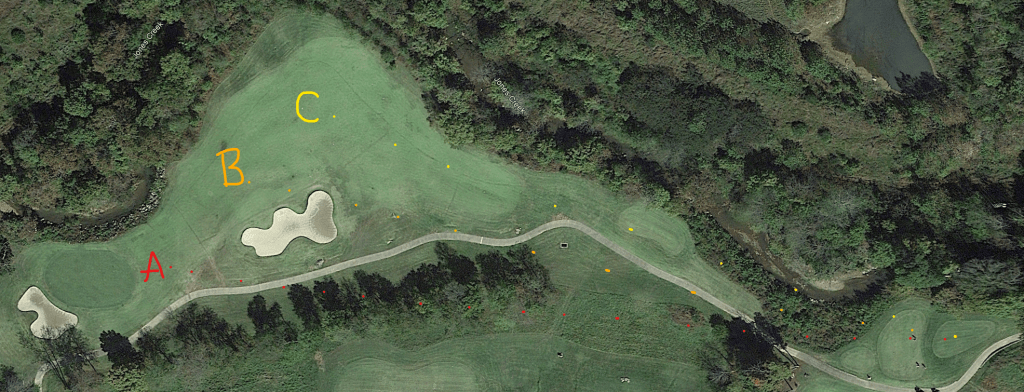
Lastly, for the less risky approach, a player can play into the fatter part of the fairway with something less than driver. This still leaves a very reasonable wedge into the green. The trickiest part of the approach is that the small creek on the right swoops the front right edge on the green a touch tighter than can be perceived from the fairway. A ball that fades slightly too much can catch that inconvenient creek on a shot that only misses by a few yards.
The fourteenth and fifteenth are then straight-forward mid-length par-4s of little character. I think McCumber may have just ran out of imagination here: the fourteenth plays as a relatively flat hole, the fifteenth plays as a downhill par-4 that is long on the scorecard but loses its bite playing as much downhill as it plays.
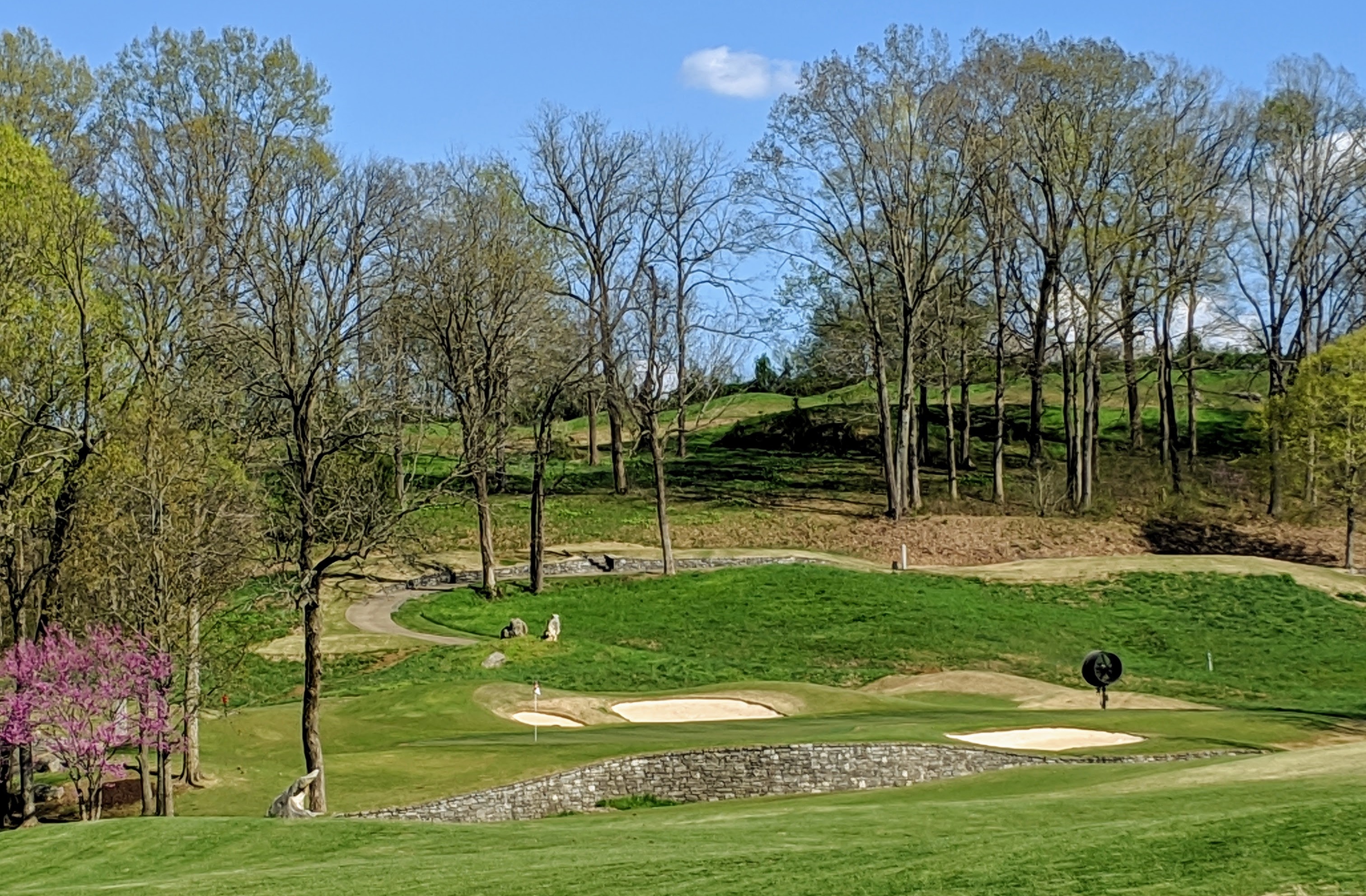
The sixteenth begin a pretty strong closing stretch of holes with the best par-3 on the course, a mid length hole that plays over the last of the grey rock walls to a green tucked between a bunker to the front right of the green and a deep greenside bunker behind the green. This green has a pronounced slope from back to front that will hold a longer-iron’s shot. This green can get very narrow though, at one point in the middle it is just 9 yards from front to back.

The seventeenth may be the most attractive tee shot on the course, but also may be one of the toughest, as it must carry a deep trench of high rough. The singular rock on the horizon serves as a waypoint.
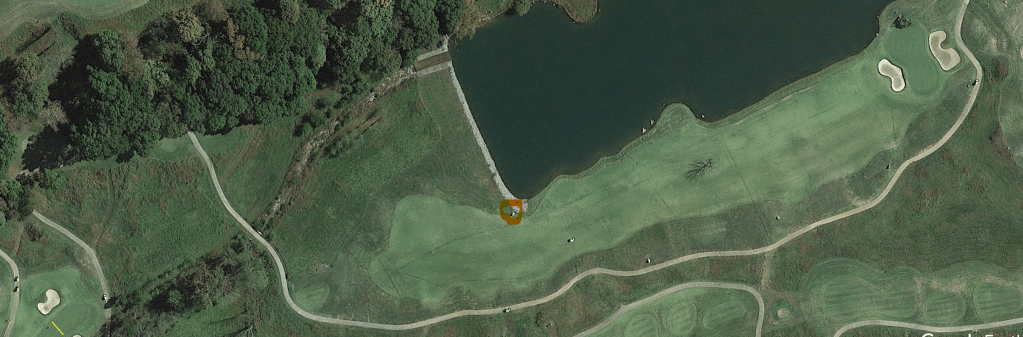
I’ve circled the rock in orange and it sits 270 yards from the par-5’s tee box. It serves as a marker: any shot left will have a very long carry to avoid the water. However, the fairway narrows from the right complicating the tee shot to the right of the rock. With the right wind, it might make more sense to take 3-wood here into the fatter part of the fairway.
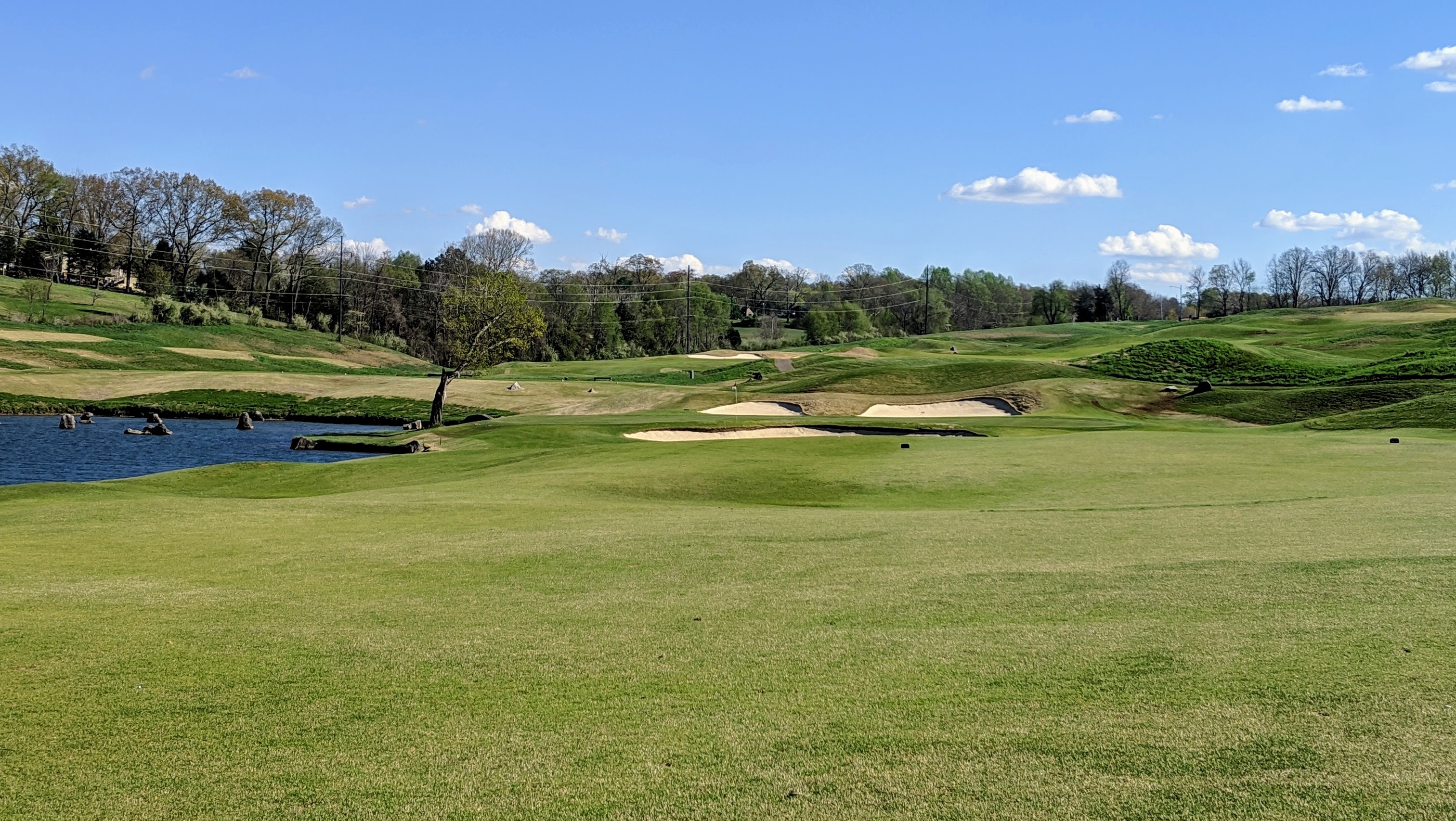
The second defining feature of the hole is a tree that resides in the middle of the fairway that complicates the approach shot, particularly if the ball finds the left half of the fairway. A deep bunker fronts both the front and back of this bunker, making it very difficult to hold this green with a longer club. While it may be reachable, it is tough to stick the landing.
Lastly, we move to the eighteenth, which has a number of incredible views. The split-dogleg right par-4 looks back up towards the clubhouse and doglegs around the hill that the clubhouse of which the clubhouse sits on top.

The eighteenth is a tough hole, as the approach shot is complicated by the meandering stream that gets very close to the green on the right – the same meandering creek that complicates drives that fade as well. However, a strong closing hole with a high scoring average due to its length.

Final Thoughts
I think it is clear to see that GreyStone has interesting design, some nice views throughout the course, and uses a piece of land that is probably too hilly to be a golf course to create a memorable design that uses those hills as an integral part of the design. GreyStone is quite a good golf course that again, provides a great value (maybe even the best value in Tennessee?) to those willing to travel outside of Nashville a little ways. However, it is not quite what I would consider a course that is truly among the best courses in state, narrowly missing, as the course conditions can vary, and some of the holes don’t present as much option as I’d like. I think this course could make the bottom end of best in state lists, with a slight redesign of a few holes and more consistent conditioning, but that would come at the expense of a higher priced round. With their location as a factor, a higher priced round doesn’t seem to be the best option. So GreyStone is a course that truly could be a first-rate public course, but is forced to be the value-brand imitation of just that. Location, location, location.
F1C’s Final Rating:
Shot Options: 7
Challenge: 6
Layout Variety: 7
Distinctiveness: 7
Aesthetics: 7
Conditioning: 6
Character: 7
Fun: 7
Total: 54/80
Rating Scale Details
> 70: Top-50 U.S.
65-70: Top-200 U.S.,
60-65: Best-in-State List
57-60: Best-in-state List Contender
53-57: Very Good
48-53: Good
40-48: Average
> 40: Poor

Author: Jaxon MacGeorge
Jaxon is the founder and lead course reviewer at First1000Courses.com. Jaxon has been playing golf for over twenty years, is a scratch handicap, and actively competes in USGA and Tennessee Golf Association (TGA) amateur events. By trade, Jaxon is an attorney and lives in Gallatin, TN, a suburb of Nashville.

 First 1000 Courses
Leave a comment