
Hermitage Golf Course – President’s Reserve is a public course in Nashville, TN. The maximum green fee is $95 per round, in peak season.
This President’s Reserve at Hermitage Golf Course course review is based on rounds played on multiple occasions between 2018 and 2023.
F1C’s Final Rating: 59/80 (Best-in-State List Contender)
Read More: How We Rate Courses
Where to stay? -> Check out F1C’s Nashville Golf Travel Guide
“Show your work!”
That is what I think to myself every time I play the President’s Reserve course and I remember: (1) this is not a course ranked on Golf Digest’s best-in-State list; (2) this is a course not ranked in GOLF Magazine’s best-in-state list; and (3) this is a course ranked #23 in Tennessee per Top100GolfCourses. I just want to ask the course reviewers to show their work.

They might not show theirs, but I will show mine. The President’s Reserve course is the best public 18-hole golf course in Tennessee and deserves to slide in to the end of these best-in-state lists around the #10 spot, give or take. It seems to check all the boxes that the reviewers typically love. A track record of solid course conditions? Yes. Houses on the course? No. Strategic par-4s of varying lengths? Yes. Good views, perhaps one on a river? Yes. A fun finishing par-5? Yes. It has all the elements of a top course, and is better than some of the courses found on those top-10 in Tennessee lists, and I’ll show my work.
The practice facility at Hermitage is nice, plenty of space to warmup for rounds, good sized practice green, chipping and pitching area, and a nice clubhouse with good food. The President’s Reserve course is a bit of a ride from the clubhouse, as it was the second course built on property several years after the first course (General’s Retreat) was up and running as a daily-fee course. However, there is a turn snack shop that serves the President’s Reserve course that typically has an employee present to make food and beverages. Everything that you’d want out of a golf course off the course is here; that is how they demand around $100/round in Nashville – the most expensive daily fee course in middle Tennessee, in fact.
But, let’s get to the golf design and try to figure out why this Denis Griffiths design hasn’t cracked those best-in-state lists.
The First Tee
The first hole is a gentle opener, a straightaway short par-4 that asks nothing from a player other than to just keep it straight off the tee. A driver, wood, or hybrid are all options off the tee that should leave a player less than 150-yards into an exposed and accessible green. Many opening hole birdies have been recorded here – its the easiest hole on the course.
After the warmup, you head to the second hole which is a departure from the first: a 630-yard par-5 that plays as a firm three-shot hole. The drive here is pretty, but also pretty open, encouraging the player to absolutely send it! The second shot is where things get interesting.

The second hole forces you into an awkward shot, however you play it. Two options exist, option A: a layup of around 200 yards fitting between the small pond on the left and a deep bunker on the right; or option B: a wood from the fairway that can take the lake and bunker out of play, but will leave an awkward length pitch when perfectly executed, and if poorly executed, brings the water on the left and out-of-bounds right quickly into play. The green has a spine in the middle, where the front half of the green sloping towards the fairway, and the back half sloping away from the player. The tricky second shot and complexities of the green mean this par-5, even for the better player, often plays over-par.
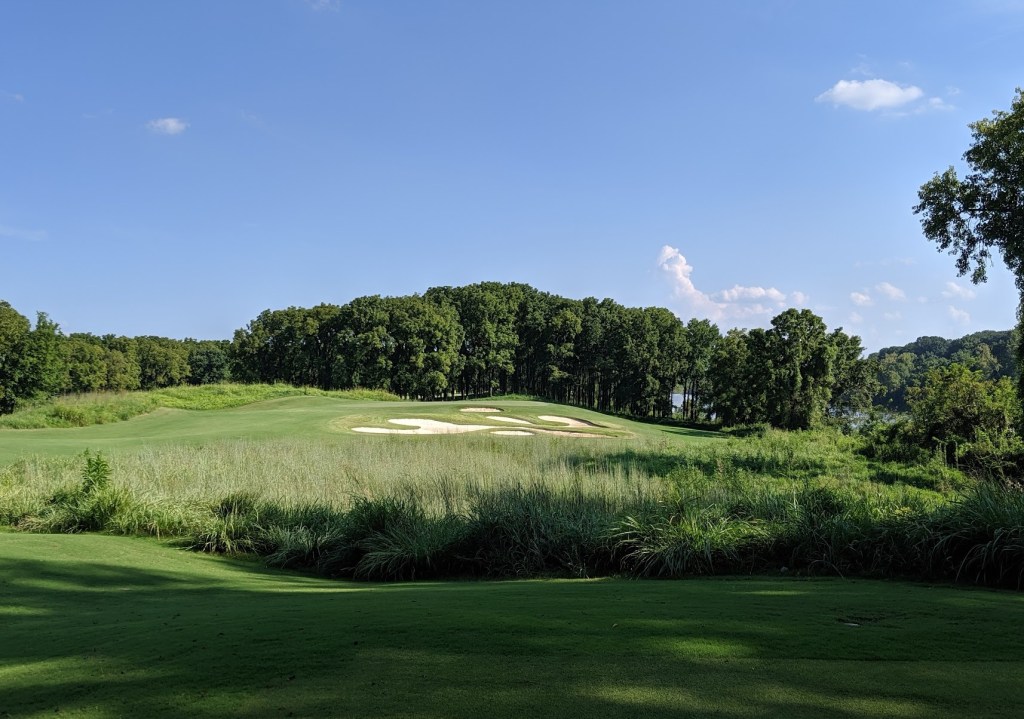
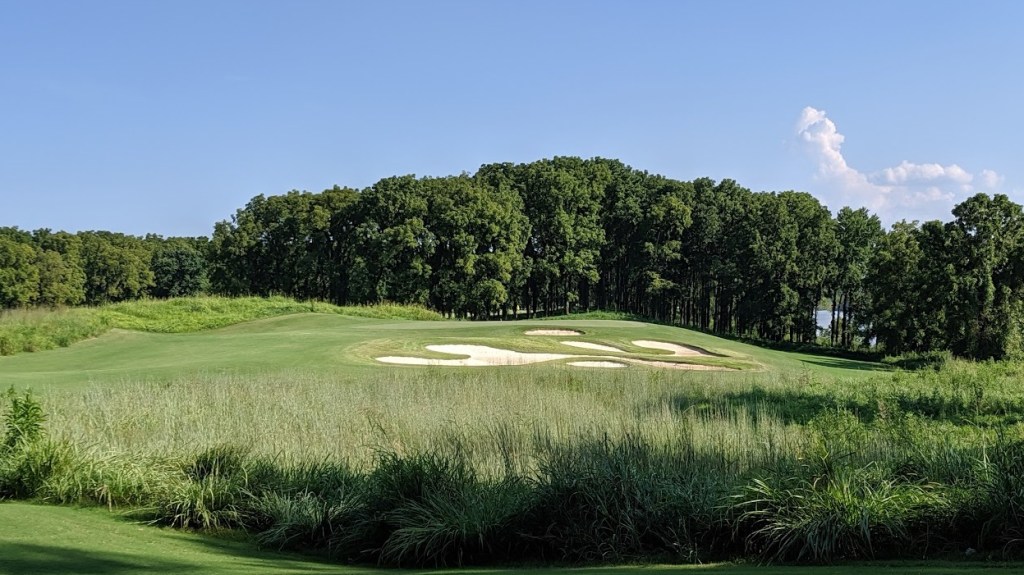
The third hole is a mid-length par-3 that would be in competition for the most attractive hole on the course, with two shot options presented. Most players will opt to carry the bunkers on the right to the center of the green, but the option exists to go a bit left, and use the left-to-right slope of the hole to work the ball into the center of the green. This green may be the trickiest on the course.
The next three holes are all strategy par-4s of varying lengths, and pack an impressive amount of variety into the first six holes.
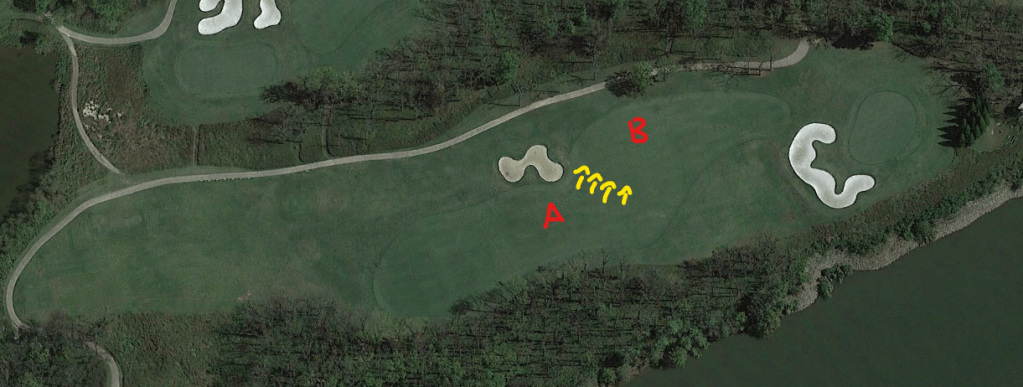
The fourth is a classic two option hole, where option A is something less than driver beside the fairway bunker, but leaves a worse angle over the greenside bunker. Conversely, if the bunker can be carried by the player’s drive, the slope will bound the golf ball down inside 120 yards or so, and will leave a wedge from a better angle to the elevated green. However, a driver hit with too much fade will run out into the rough as the fairway narrows from the left.
The fifth hole is a touch longer par-4 where a draw is necessary to find the fairway, and should leave a mid-iron into a bunkerless green.
On the sixth hole, Griffiths again forces the player to choose between two basic options.
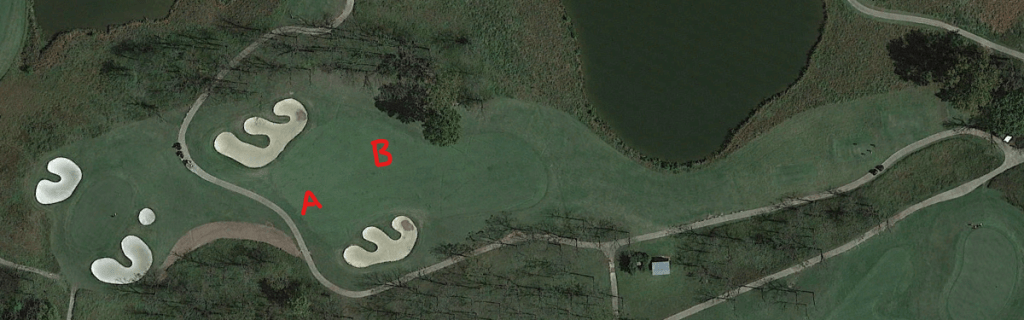
A short par-4, the hole gives you the green light to hit the driver up near the green, but as you can see, there is a bit of tightening, and past the cart path, the ball typically bounces left towards the higher grass if it carries the bunker, and finds a deep fairway bunker on the right if faded too much. Option B is a wood or hybrid layup, which will leave between 120-150 yards, but brings the left bunker into play on pulled shots.
So, lets pause and reflect on those first six holes: four par-4s all of different lengths and strategies, a difficult par-5, and a riverside par-3 – seems like a sufficient amount of distinctiveness and layout diversity.

The seventh turns to a long par-3 of some 230 yards into a tight green; a straightforward hole that plays as one of the most difficult due to the length of the hole.
Admittedly, the eighth hole is a fun hole, and becomes more fun the more you play the medium-length par-5 and understand the angles of the hole better. Most players can hit driver from the tee, but right of target here is a death sentence. The approach plays uphill, but given the right angle, longer players will have a realistic shot of hitting this green in two.
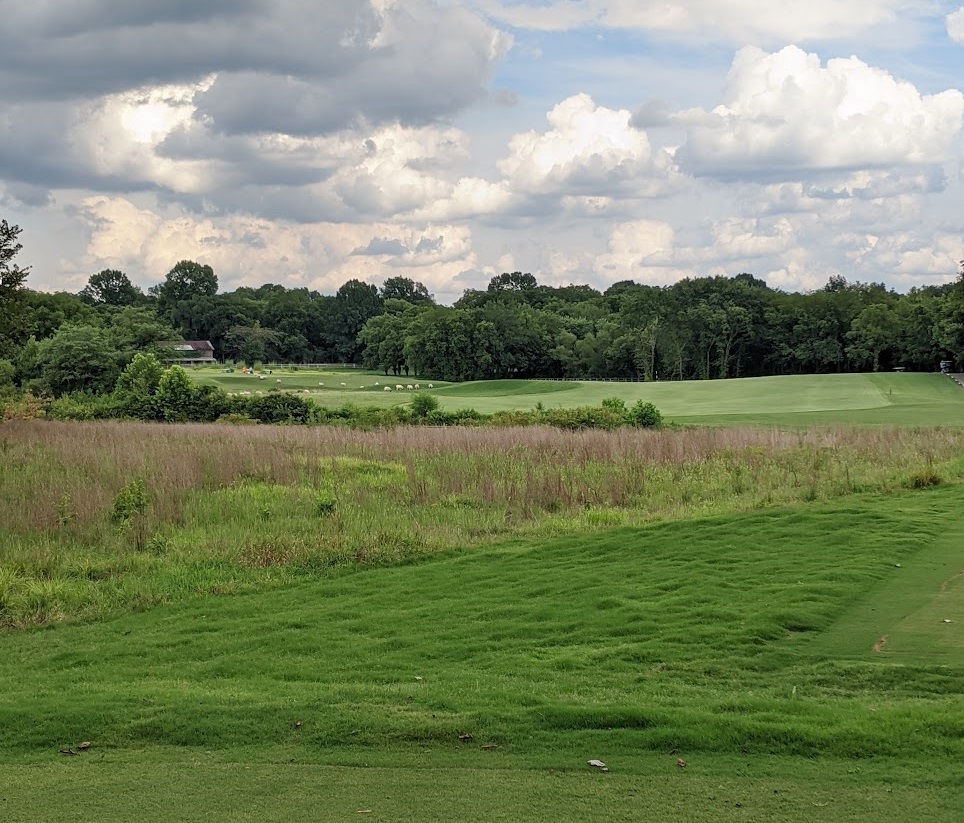
Turning to the ninth, a medium-length par-4, this is a hole that has changed for the worse in recent years. It is still a good hole, a tough drive over some grass bunkers into a fairway that is wider than it appears. However, these grass bunkers used to split the fairway, with around a third of the fairway residing to the left of the grass bunkers.

This was a poor choice by the golf course, in my opinion. The old design gave the player an opportunity to get it closer to the green by going into the narrow bit to the left of the grass bunkers. The elimination of that left side fairway makes the grass bunkers look out of place.
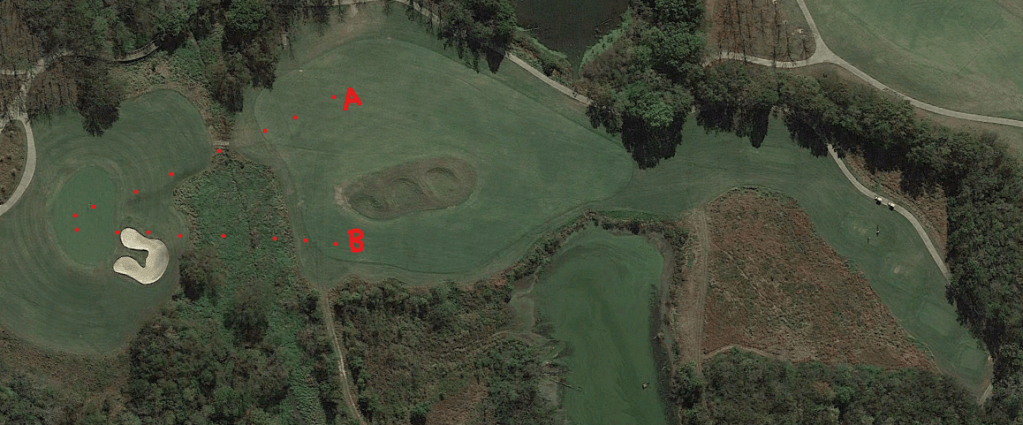
On the old hole, the player had two options: Option A into the wider part of the fairway, leaving a longer approach but a better angle or Option B into the narrow part of the fairway, leaving a shorter approach from a worse angle.
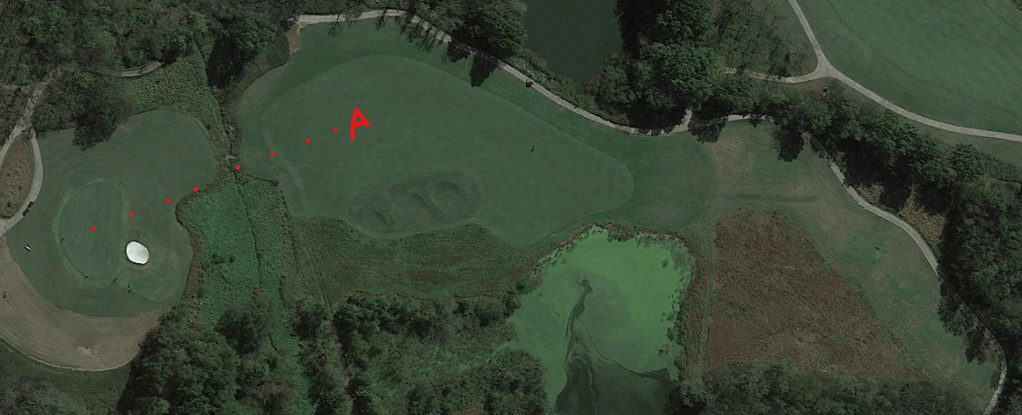
On the new hole, it has been narrowed to a single option par-4, the equivalent of a sin in the golf design world on a nine-closing hole. However, the hole is still fine, but went from one of the better holes on the course, to an unremarkable par-4.
Making the Turn
After the turn, the tenth is pretty similar to the first hole, just a touch tighter. However, the straightaway par-4 often leads to a birdie opportunity if you can tame one of the more aggressive putting surfaces on the course.
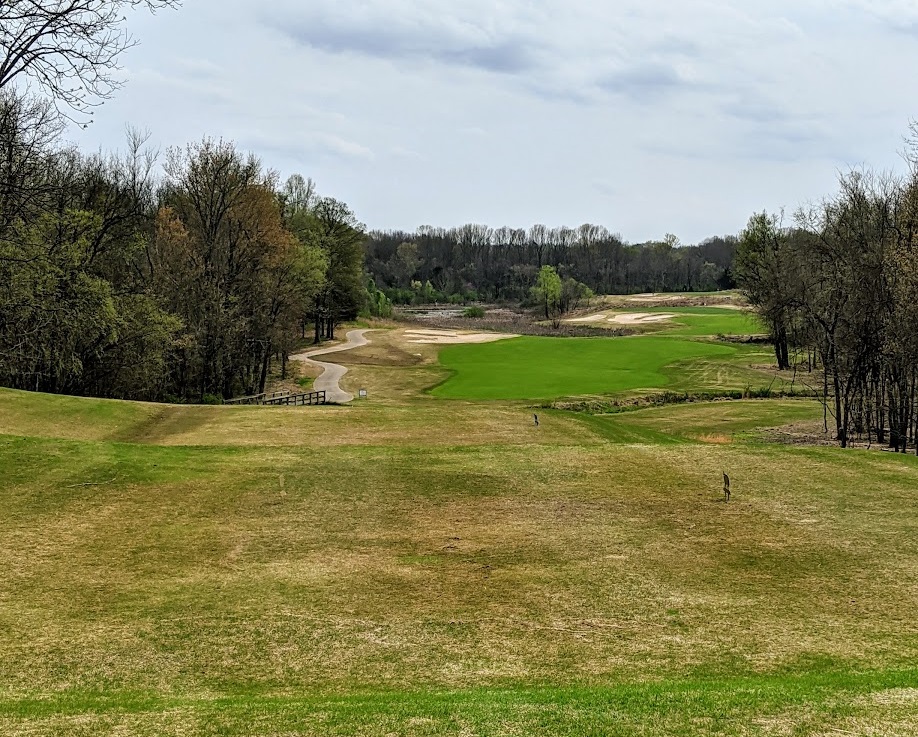
The eleventh hole is the signature hole at the President’s Reserve, a downhill tee shot into an area tightened by a large bunker on the left. The second shot plays back up the hill, over a marshy floodplain by the river and a few very deep greenside bunkers.
The twelfth is a nice mid-length par-3, but is otherwise uninteresting.
The thirteenth plays the tee shot over a tributary of the river. The long par-4 has quite the optical illusion with a bunker that appears greenside from the fairway, but is actually about 70 yards short of the green.
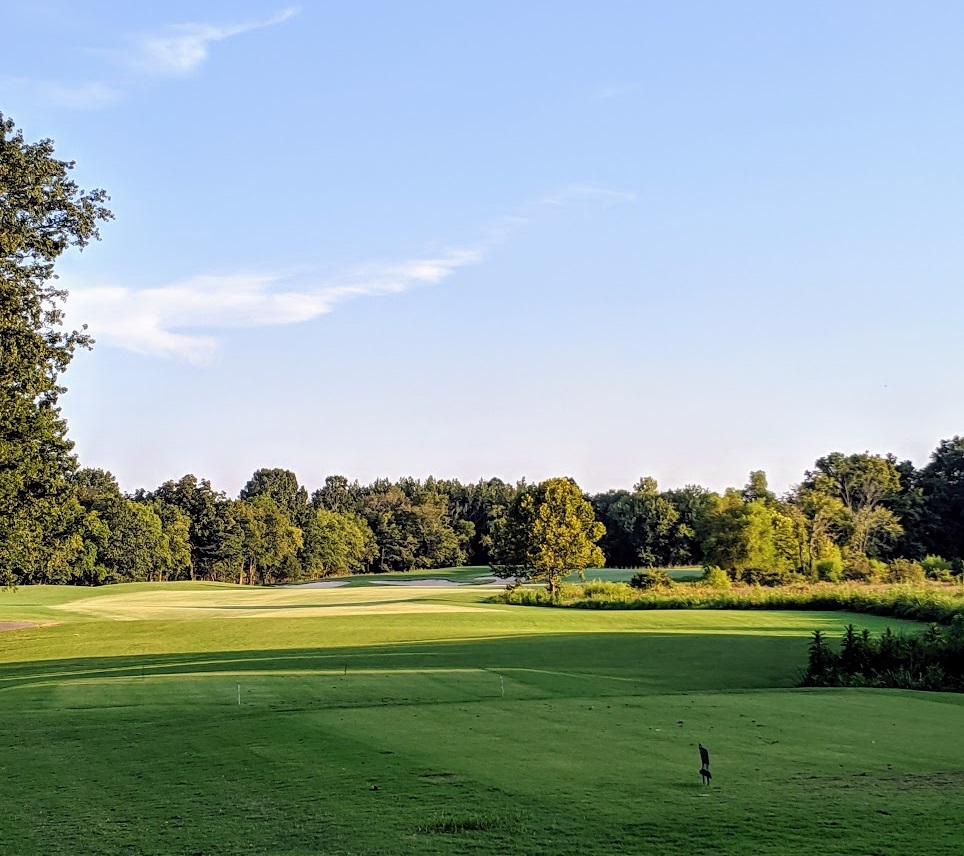
The fourteenth hole is another long par-5 that plays as a three-shot hole for all but the absolute longest players. The fairway bunker is out of reach from the tee but frames the tee shot nicely. This green is pitched from back-to-front and the player must control the spin in order to keep the wedged third shot from spinning back too far, especially to front pins.

Fifteen is a par-3 that is in heavy competition with the third hole for the most photogenic award, with a steep drop-off left of the hole. The green area is relatively elevated actually, with a less severe drop off on the right eventually as well.
Sixteen is a connecting par-4, a straight mid-length par-4 that may produce a good birdie opportunity.
The seventeenth hole is another shorter par-4 that has many options for the player to contemplate.
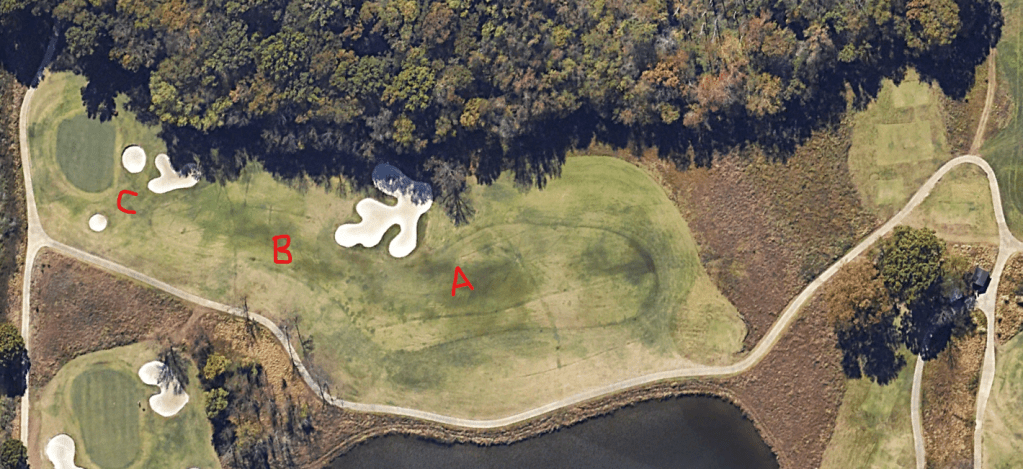
The hole is only 300-yards from tee to green, so three options emerge. Option A is probably the best option, an iron from the tee, leaving a 9-iron or pitching wedge into the green. This technically brings the water into play on the left, but only on the worst pulls. Option B would be a wood off the tee, but the narrowing from the left makes this a precise shot for little reward: getting a sand or lob wedge in hand for the approach. Lastly, Option C is to send it into a narrowing area with deep bunkers, hoping to drive the green or leave a short chip shot to set up a birdie look. These options make for a great seventeenth hole in match play formats, because the multiple options and the player’s evaluation of their risk and reward could be the difference in a tight match.
The eighteenth hole is a par 5 that plays over the widest part of the tributary from the Cumberland River.
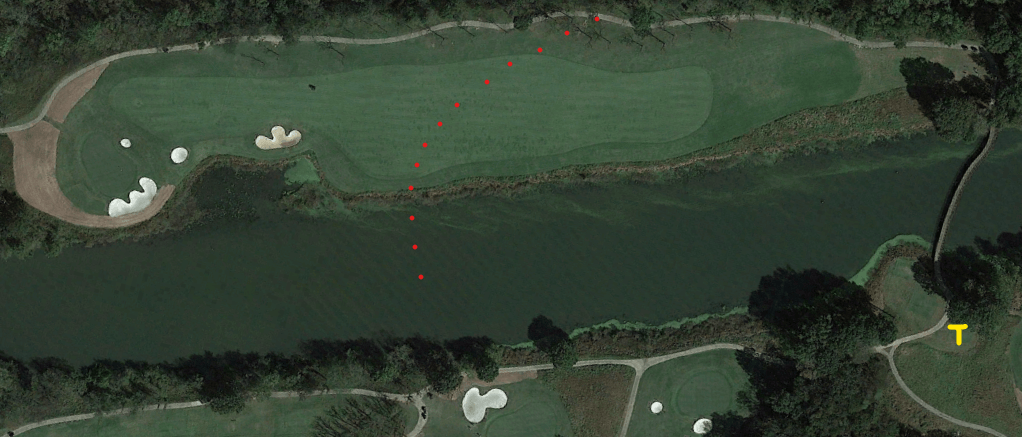
The option is driver here, but the option becomes the target that the player chooses, as the further left the player go, the more lake is taken on, as this tee shot plays at about a 45-degree angle to the fairway. Too far right is no good either, as the right hand trees often result in a lost ball. The further left the target, the better chance for eagle and for double bogey. At only 500 yards, this is one of the few par-5s that, through the use of angles, can result in a mid-iron into a par-5.
Final Thoughts
So what have I shown you here? I’ve shown you holes with shot options, holes with difficulty, holes with great aesthetics, and holes with a distinctive character. The President’s Reserve course is truly a complete golf course, and while nobody would mistake it for the very best in state, it is a well-above average course from a design perspective. Most of the holes present real options, and the player’s calculation of those options can be the difference between a close match.

I guess the President’s Reserve doesn’t have enough character? Just kidding, that can’t be it, because what other course lets Scottish Blackface sheep just roam around the course grazing the land?
Perhaps a few, but not too many, I’d say, which is exactly how many courses in Tennessee are better than the President’s Reserve course: Perhaps a few, but not too many.
F1C Final Rating
Shot Options: 9
Challenge: 6
Layout Variety: 8
Distinctiveness: 7
Aesthetics: 7
Conditioning: 8
Character: 7
Fun: 8
Total: 59/80
Learn More: How We Rate Courses
Rating Scale Detail
> 70: Top-50 U.S.
65-70: Top-200 U.S.,
60-65: Best-in-State List
57-60: Best-in-state List Contender
53-57: Very Good
48-53: Good
40-48: Average
> 40: Poor

Author: Jaxon MacGeorge
Jaxon is the founder and lead course reviewer at First1000Courses.com. Jaxon has been playing golf for over twenty years, is a scratch handicap, and actively competes in USGA and Tennessee Golf Association (TGA) amateur events. By trade, Jaxon is an attorney and lives in Gallatin, TN, a suburb of Nashville.

 First 1000 Courses
Leave a comment