
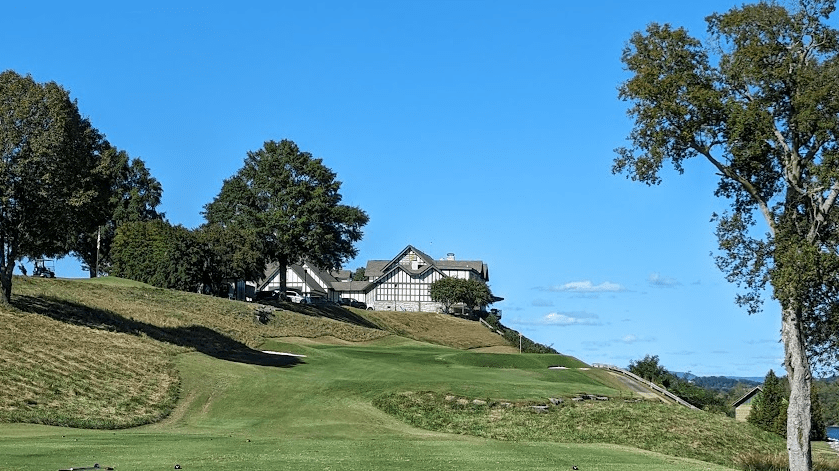
Chattanooga Golf & Country Club is a private course in Chattanooga, TN.
This Chattanooga Golf and Country Club course review is based on a round played on October 6, 2023.
F1C’s Final Rating: 57/80 (Very Good)
Learn More: How We Rate Courses
Chattanooga Golf and Country Club is a course that comes with a lofty in-state ranking and a decent amount of expectation. The course just hosted the Tennessee State Amateur a few months before my visit and was presumably in about the best shape possible. The greens were simply the fastest greens I’ve ever played. So much so, that I’m not sure that it is physically possible for greens to be faster. A golfer would need weeks to truly adjust to the speed of these greens and put together a proper putting performance.
The course is ranked by Golf Digest as the 10th best in Tennessee, but GOLF.com has it as 8th and Top100GolfCourses.com rates it as 9th in the State. The course is a Donald Ross, retouched by Bill Bergin in 2005. Of note, I am currently a member at a 36-hole club in Gallatin, TN; both courses are Bill Bergin designs, and I quite like both courses. Chattanooga G&CC being higher ranked than ours here in Gallatin, I came into this round with lofty expectations.
From my time routinely playing a Bill Bergin course, Bergin has a few unique design principles that he repeatedly uses in his courses, like Tennessee Grasslands, McLemore, and here at Chattanooga:
(1) a unique bunker design, featuring large, ovular bunkers with steep grass faced lips and flat bottoms; and,
(2) elevated greens with run offs.
Therefore, typically Bergin courses are second shot/short game courses that require general precision, rather than exacting execution. The putting surfaces are typically rather tame, so anywhere on the green will suffice on Bergin’s designs. Conversely, missing the green often comes at a steep penalty, either resulting in a ball buried in a steep faced bunker or a ball 30-yards away, as it bounds down the face of an elevated green.
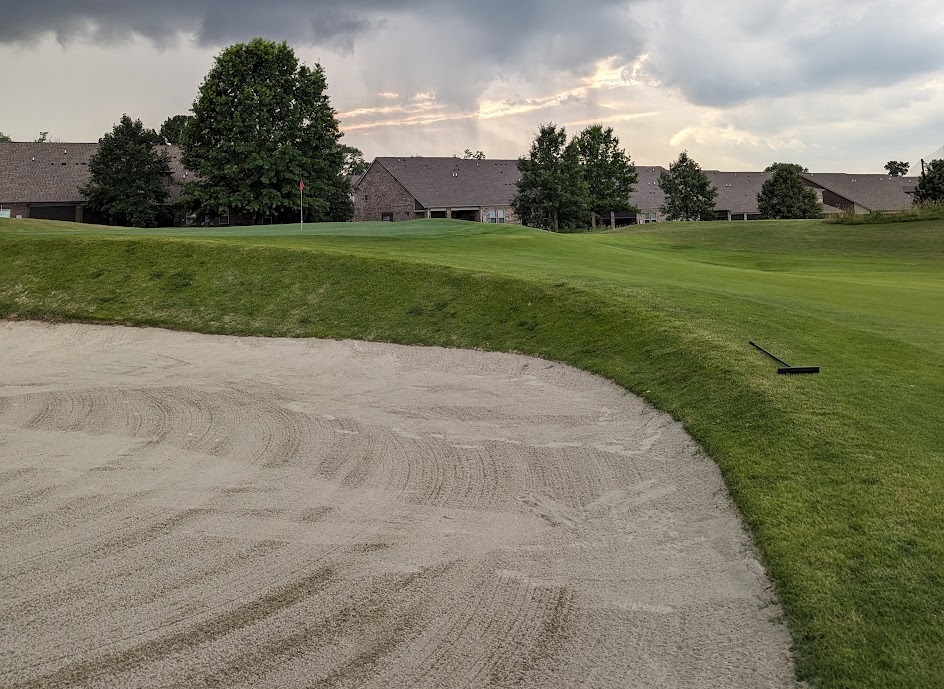
All of this to say: I knew what to expect from a design element, and I had high expectations. Nothing I am about to say is a personal dig at Bergin (or whomever the decision makers were), but I left feeling that certain holes maxed out their potential, while other holes were the minimum of their potential.
There are good holes on this golf course, but there is the weight of too many holes that are not great holes, or fail to realize their potential. I can’t fault Bergin for all of it, a large portion of my complaints will be simply that this golf course does not possess the requisite acreage for the modern game. However, I’m not sure that Bergin did his best design work at Chattanooga G&CC.
The First Tee
The first hole is probably the best view on the course. The clubhouse is perched atop the largest hill on the property, and directly underneath the clubhouse is the first tee. The entire course is situated along the river, and no hole features the river quite as well as the first.

For as good as the hole is optically, the river was always there. The hole was always going to be pretty, even if it wasn’t necessarily a good golf hole. Coincidentally, the golf hole that is the first hole is not a good hole, and is the first example of a hole that is making the least out of its geographic placement.
The hole actively plays away from its best feature, the river, with the introduction of the two fairway bunkers on the right. These bunkers provide no strategic value, other than to catch balls that might be river-bound and keep them in play.
To borrow a concept from Scott Fawcett and DECADE, the aiming point with a drive on this hole should be at the left bunker. Why? Because Bergin has essentially left the entire left-hand side of the tee shot completely unguarded. There is no reason to even contemplate a golf ball visiting the river, if the player is picking a correct target.

The way the hole currently plays, better players simply aim at the left bunker. If they push it, the ball will find the fairway; if they pull it, its a simple rough shot from an even better angle than the fairway. It is poor hole design: routing a hole away from its most attractive but dangerous feature by leaving a large, unprotected bailout area on the other side. As The Fried Egg pointed out long ago, this is also Torrey Pines’ greatest error, and Bergin is far from the first designer to make this error.
If the two bunkers were removed, and the fairway taken over to the edge of the river’s rock cliff, this would force a player to take on the possibility of hitting their first tee shot into a river, or finding well positioned bunkers in the left-hand bailout area, like so:
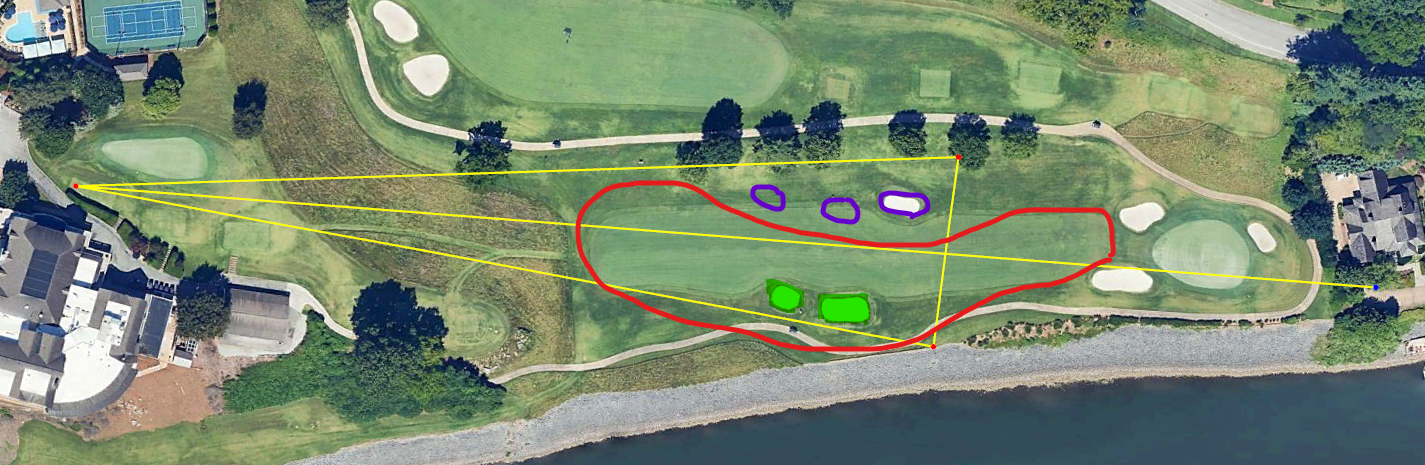
If designed like this, a shot pulled finishes in a set of bunkers and rough, while a shot pushed gets uncomfortably close to a river; unquestionably a better golf hole and the same view to boot.
The second hole is a mid length par-4 and the third is a long par-4. They are straightforward holes. While pleasant, they weren’t exactly a challenge for the mind: driver-iron, driver-iron. Then comes the fourth, a medium-length par-5 which was one of the more interesting holes on the course, with a somewhat-tight drive and an interesting approach to an elevated green.
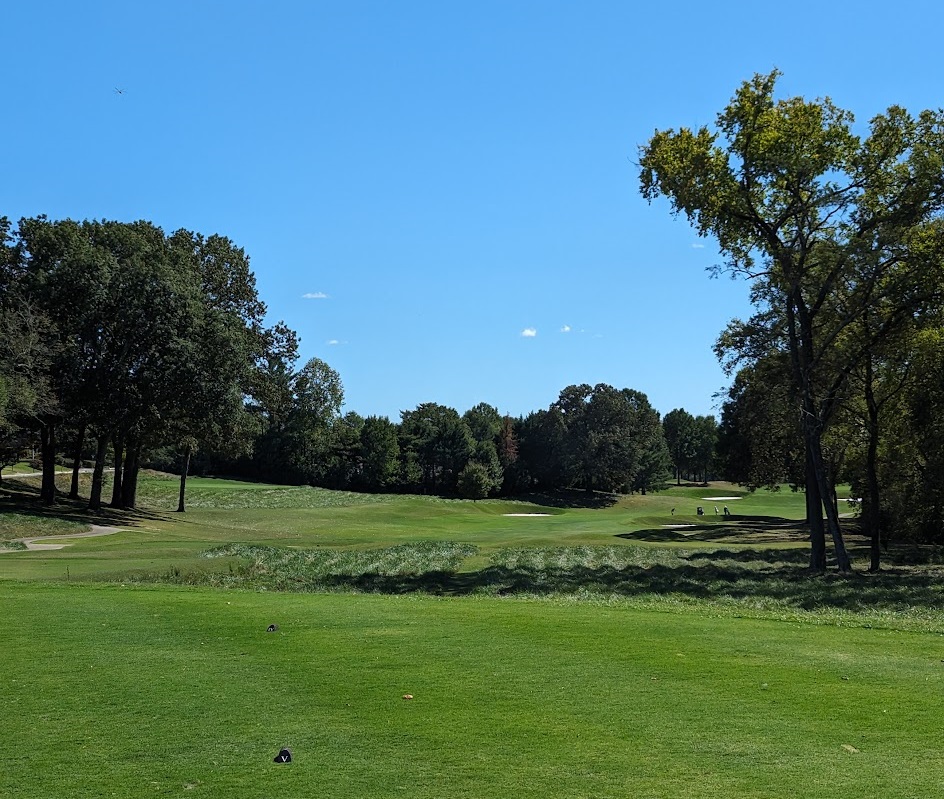
The fifth hole is a mid-length par-3, but the most impressive part of the mundane hole is the mansion that sits on the hill behind the green. I’m pretty sure I saw a chandelier larger than my SUV.
The sixth hole comes and, while I want to say its the worst hole on the course, it probably is not. Largely a forgettable hole is the sixth, a straight-away par-4, but for the fact that I remember it being impossibly tight and flanking a community on the right. This is when I realized that what we were dealing with was half design issue, and half a usable space issue. This hole needs to be several yards wider to be a reasonable golf hole. Instead, I’m sure the houses on the right take a daily pounding from the never-relenting slices of 10 handicaps.
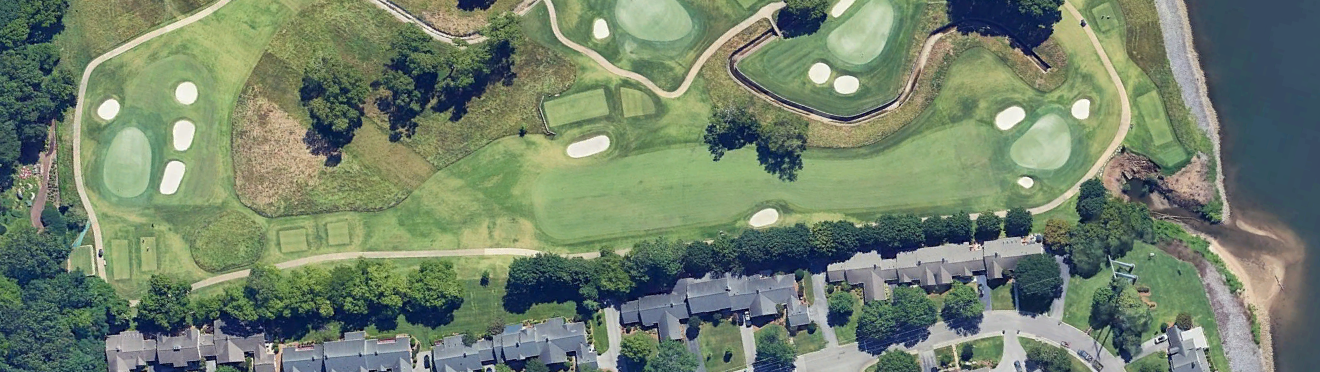
The hole feels like an afterthought, as if Donald Ross needed to get from one side of the course to the other, this was the corridor in which he had to do it, and whatever the result was: so be it.
The seventh and eighth holes, a par-4 and par-5 turn and run parallel to the river, but don’t provide the views you’d expect from river holes, due to the elevated and flat nature of the land on this part of the course.
The ninth is, in my opinion, the star of this show: a long par-3 with a very elevated green which presents multiple options on how to best attack the hole with a long iron. The clubhouse sits perched atop the hill behind the hole, and the river seems in play (because it is) due to the extreme slope right of the green. This has to be the most photographed hole on the course, and my camera happily obliged.
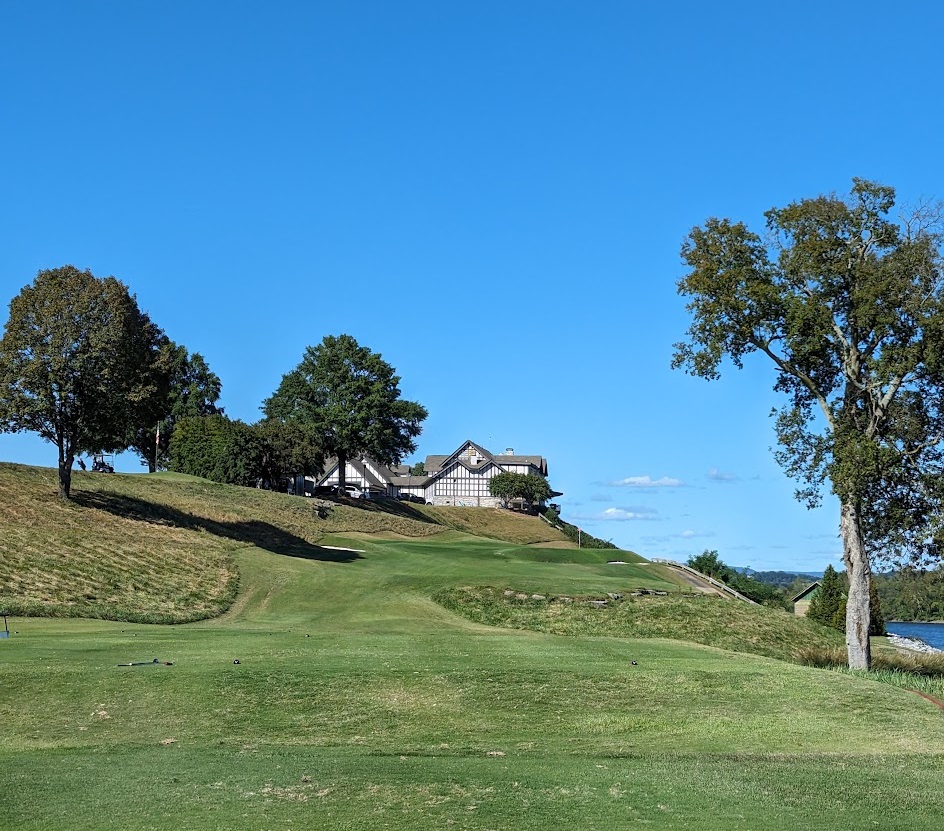
The front nine routes counter-clockwise around the perimeter of the property, and the back nine would head internal to do a maze like counter-clockwise loop around the interior of the property.
Making the Turn
The tenth hole starts off the back nine and is a hole more fitting of your local municipal course than a course ranked in the state. The hole is a short-par 4 that doglegs around the driving range. The line on the image below is 300 yards.
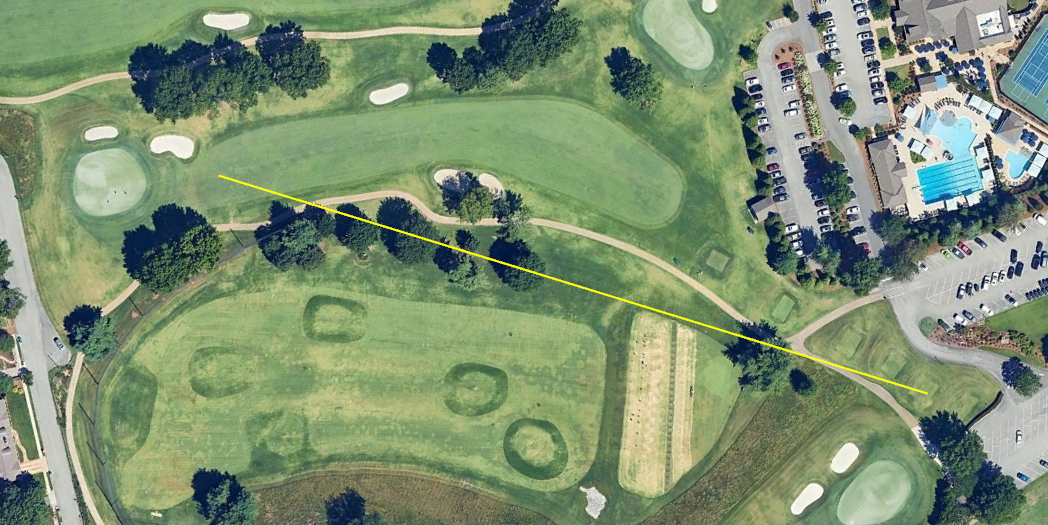
I assume this is mostly just due to the lack of space, but a proper hole may have the tee boxes somewhere back in that parking lot, with taller, denser trees protecting the driving range tee line. Rather, in this case, I sent a steaming fade over some folks that were warming up for their round and found the fairway. Absolutely nothing, apart from some medium-height trees on the right, stop you from doing so. The group behind mine had the same plan, as they nearly hit me in the fairway while I played my approach. This is an awful hole.
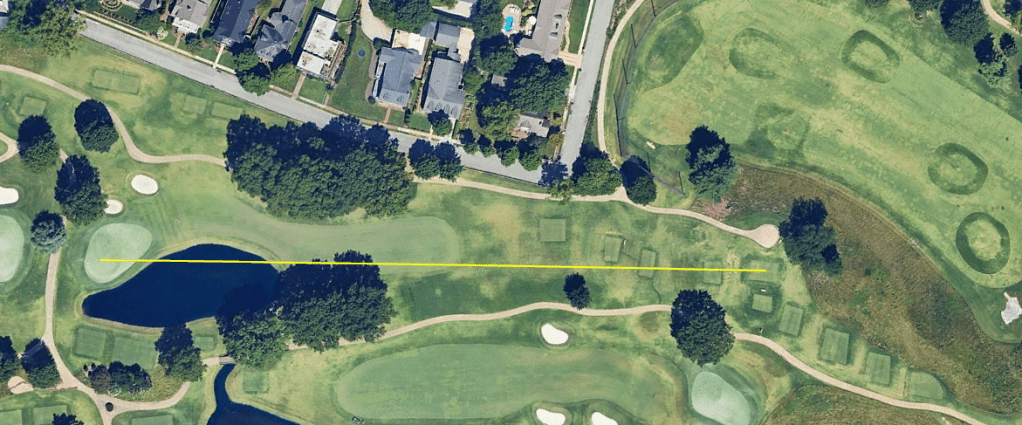
The eleventh is a bit of a drive in the cart up a hill to the other side of the driving range. This time, a short par-4 plays down a hill to a driveable green if you have the guts to take on the large frontal lake that quarters the front left of the green. Perhaps the second or third best hole on a very weak nine, and one of the few that add character. The line in the image below is also 300 yards.
The twelfth hole is a forgettable narrow par-4 with a bit of a forced carry before the green. The thirteenth is an interesting par-3 with a batting cage style net behind you to prevent wayward shots from the sixth tee from decapitating you; very confidence inducing.
However, the thirteenth is a typical Bergin par-3 that finds its beauty in an elevated green with bunkers pressed like thumb prints into the slopes flanking the green. The fourteenth then moves away as a medium-length par 4 that is narrow and largely forgettable.
Notice I keep saying forgettable, but it did not have to be this way. You see, this area of the course (five, six, twelve, thirteen, fourteen) have a very interesting (yet out-of-place in East Tennessee) burn in them that appears to serve as drainage through a culvert to the river. This is certainly a unique feature to find in Tennessee rather than say, St. Andrews. However, the burn is not used as a design element at all in the entire course; another failure of design.
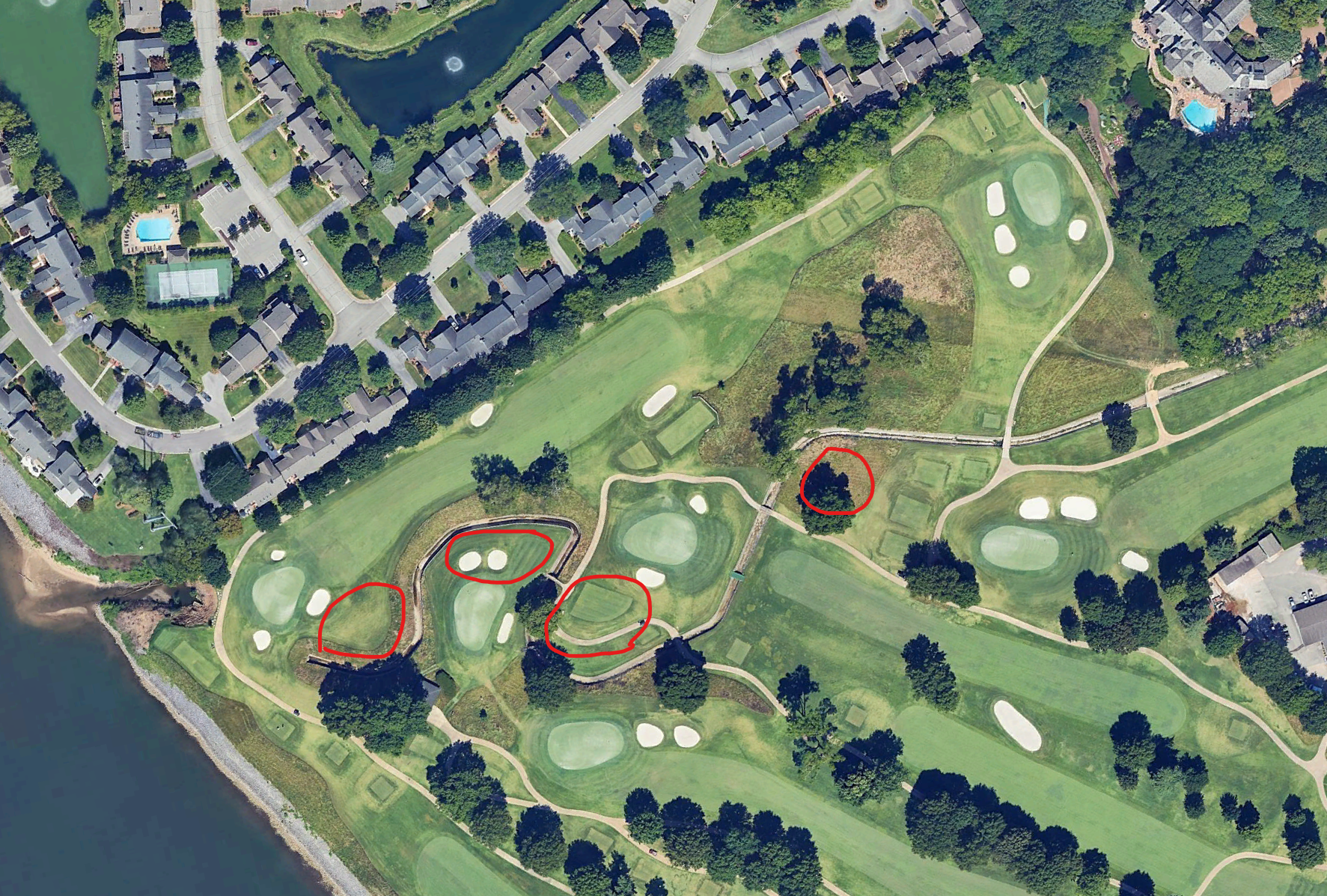
As the image above shows, there are plenty of empty areas for the burn to be used. To the right of the sixth, fronting the thirteenth, to the right of the twelfth, and to the left of the twelfth lay areas of land where the burn could be used as a golf hazard. Rather, it was ignored as a design element. Imagine if St. Andrew’s first green just had elected to not use the burn as a hazard on its first hole. There may well be a reason why the course does not use these burns, but it is currently lost on me.
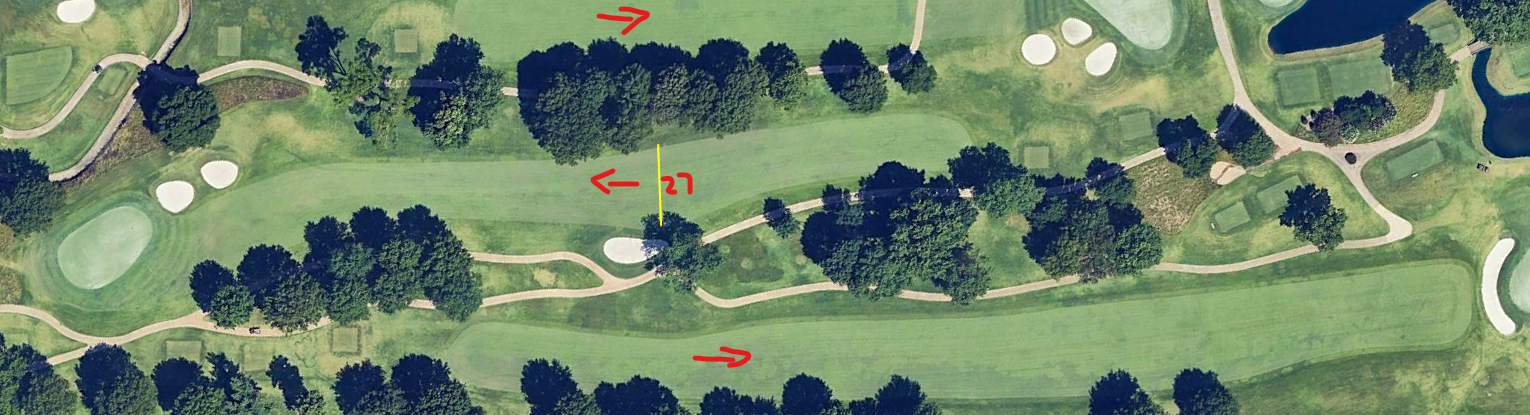
The back nine proceeds to go on a tear with fourteen, fifteen, and sixteen being overly narrow, parallel holes crammed into a space where only two holes can fit. On the fifteenth, a very long par-4, the player has a mere 27 yards to hit a Driver, making these holes more luck of the bounce than a true test of skill. This area of the course again reminded me of an old municipal course rather than a golf course considered one of the best in state.
Finally the painful, narrow monotony ends with two good finishing holes. First, the par-4 seventeenth, which finally allows Ross/Bergin to incorporate some strategy besides “drive it long and straight and then do it again with your iron.”
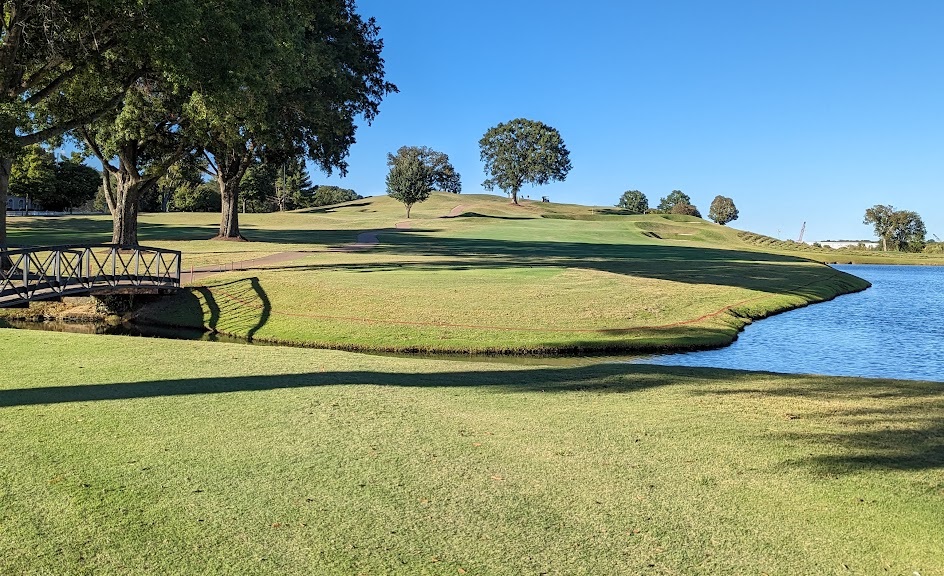
The sun started getting low in the sky so the picture does not do the hole justice, but it is finally a hole with a few options.
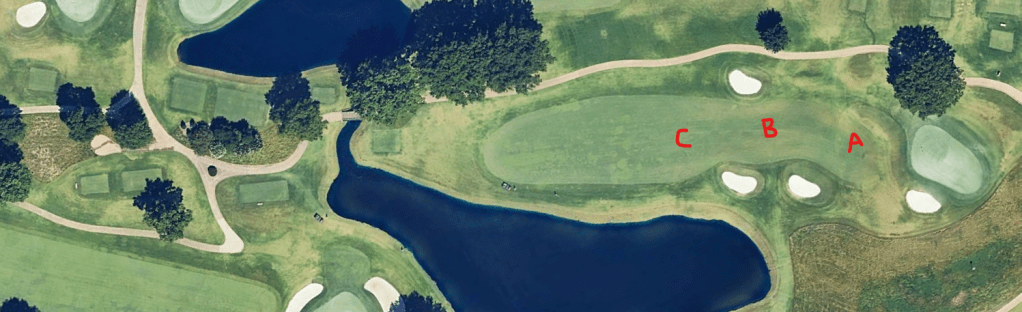
As you can see, the hole plays dramatically uphill, with three basic options.
- – Option A would be to drive it as close as possible, but due to the slope of the hole, this makes the putting surface and pin all but disappear if you are short, and could even result in a bit of roll back. Therefore, Option A leaves the possibility of a difficult chip.
- – Option B is clearly superior, leaving a wedge into a flag that can be seen, but the landing area is fortified by bunkers left and right. Lest we not forget, Bergin’s fairway bunkers are often pitch outs if the ball comes to rest in the front half of the bunker, due to the steep lips. Generally, they are to be avoided.
- – Option C will bring the water into play on a fanned shot, and a longer iron into the green on well struck tee shots, but presents some bailout area left that still preserves an angle.
This hole baits you into being aggressive, but I am not sure that the conservative Option C wouldn’t produce the lowest scoring average over multiple rounds.
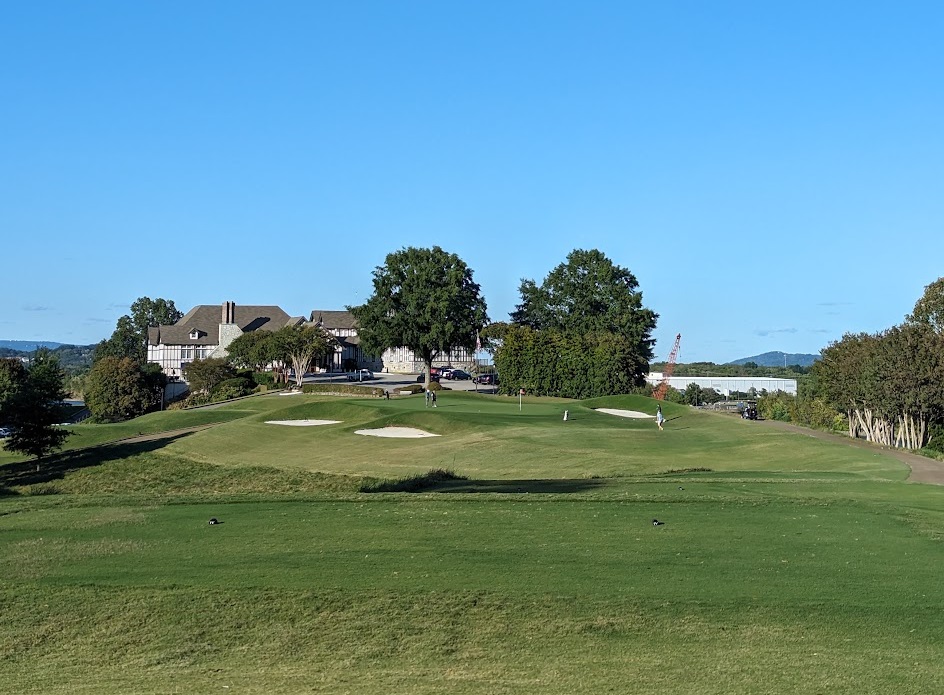
The finishing par-3 eighteenth is a solid long-par 3, and admittedly, I love finishing par-3s and the fact that both nines finish with a par-3. Mark that one for a point in the character category. Its also a very aesthetically pleasing hole.
Final Thoughts
So, yes, in conclusion, I was harsh on this course. Honestly, the course is a good course. There’s nothing so wrong about the course that creates a poor playing experience – its a good course and I’d consider membership if I were in Chattanooga, for the right price. This harsh review is a more a lesson in expectation management, because I had been under the impression that this was a best-in-state type contender.
This course is a good course with history, a robust membership, and great playing conditions, but it is not one of the best courses in Tennessee, and there’s nothing wrong with that. It is, however, a course with some of the best par-3 holes and fastest greens in Tennessee, but that is all, and going in with that more reasonable expectation is probably the key.
F1C Final Rating
Shot Options: 7
Challenge: 8
Layout Variety: 7
Distinctiveness: 8
Aesthetics: 7
Conditioning: 7
Character: 8
Fun: 5
Total: 57/80
Read More: How We Rate Courses
Rating Scale Detail
> 70: Top-50 U.S.
65-70: Top-200 U.S.,
60-65: Best-in-State List
57-60: Best-in-state List Contender
53-57: Very Good
48-53: Good
40-48: Average
> 40: Poor

Author: Jaxon MacGeorge
Jaxon is the founder and lead course reviewer at First1000Courses.com. Jaxon has been playing golf for over twenty years, is a scratch handicap, and actively competes in USGA and Tennessee Golf Association (TGA) amateur events. By trade, Jaxon is an attorney and lives in Gallatin, TN, a suburb of Nashville.
 First 1000 Courses
Leave a comment